
Understanding Your Family Health History: A Guide to Empowering Your Future
- QCHC Communications

- May 26
- 13 min read
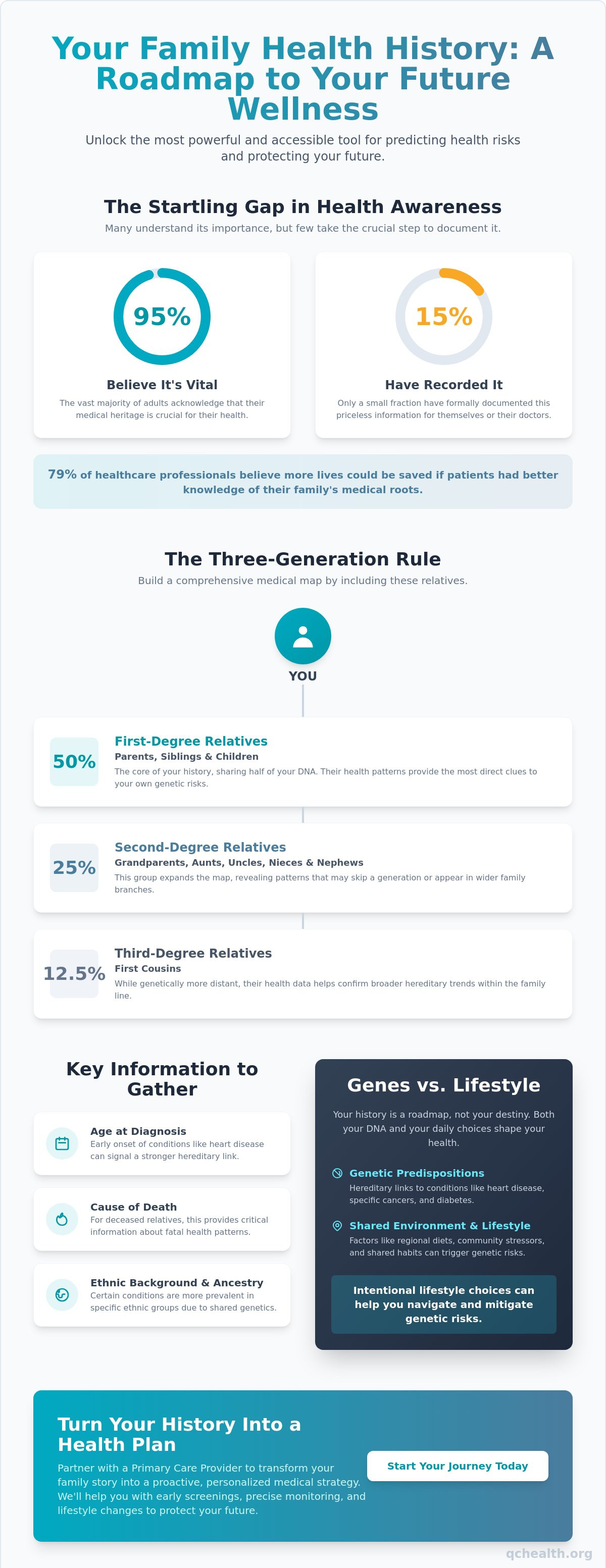
Did you know that 95% of adults believe their medical heritage is vital, yet only 15% have actually recorded it? It's a staggering gap that leaves many of us feeling anxious about our future. We often worry about hereditary conditions like diabetes or heart disease; however, cultural stigmas or a lack of contact with older relatives can make the process feel impossible. Understanding your family health history shouldn't be a source of stress. It is a powerful tool for your wellness. It is a roadmap for your future.
We understand that talking about illness can feel uncomfortable or even intrusive within some families. You're not alone in feeling that way. This guide will help you overcome those barriers and build a clear plan to gather your health data safely. You'll learn how to use this information to predict risks and prevent illness before it starts. We will explore how to use modern tools and how to partner with your primary care provider. Collect your data. Predict your risks. Protect your future. Your health is a shared responsibility, and it begins with your story.
Key Takeaways
Learn why understanding your family health history is the most powerful and accessible tool for predicting your future wellness and longevity.
Identify the specific first and second-degree relatives needed to build a comprehensive three-generation medical map for your family.
Discover how intentional lifestyle choices can help you navigate genetic risks, proving that your medical heritage is a roadmap rather than a destiny.
Gain practical strategies for opening healthy dialogues with relatives to overcome cultural stigmas and preserve your community's health legacy.
Learn how to collaborate with Primary Care and Specialty Care providers to transform your family story into a proactive, personalized medical strategy.
Table of Contents
What is Family Health History and Why Does It Matter?
Your health story is written in the lives of those who came before you. It is a shared biological and environmental legacy that connects your past to your future. While modern medicine offers complex screenings, understanding your family health history remains the most affordable and effective genetic test available. It is a record of the medical conditions, lifestyle habits, and environments that your relatives have experienced. By looking at what is a medical history through the lens of your lineage, you provide your doctor with a powerful predictive tool.
The data is clear. Nearly 79% of healthcare professionals believe more lives could be saved if patients had better knowledge of their family medical roots. This information allows your Primary care provider to spot dangerous patterns long before symptoms ever appear. It moves the conversation from reacting to a crisis to building a fortress of prevention. When we identify these patterns early, we can tailor your care to fit your specific biological needs.
The Power of Patterns: Recognizing Hereditary Risks
Certain conditions have incredibly strong family links. Heart disease, diabetes, and various forms of cancer often travel through generations. We look specifically for "early onset" cases. If a parent or sibling developed a condition at a young age, it signals a higher risk for you. This knowledge changes everything. It means we can start screenings earlier. It means we can monitor your health with more precision. Proactive prevention is always more effective than reactive treatment. By recognizing these hereditary links, you empower yourself to take action before a diagnosis occurs.
Beyond Biology: Shared Lifestyles and Environments
Family history is about more than just DNA. It includes the air you breathe and the food on your table. Families often share regional diets, local environmental factors, and even community stressors. These shared habits can be just as influential as your genes. For instance, understanding these external factors is vital when managing hypertension or other chronic stressors. Your environment can act as a trigger for your genetic predispositions. By identifying these shared risks, we can work together to change the narrative. We help you build new habits that protect your health and the health of the generations coming after you. Your history is not just a list of illnesses; it is a roadmap for community wellness.
The Three-Generation Rule: Who to Include in Your History
Building a complete health map requires looking beyond your immediate household. We recommend the Three-Generation Rule. This is a systematic way of identifying who belongs in your medical story. Understanding your family health history starts with your inner circle, but it must grow to include the branches of your extended family tree. The importance of family health history lies in the depth of information you collect; it's about seeing the full scope of your biological community.
To get a clear picture, categorize your relatives into three groups:
First-Degree Relatives: These are your parents, siblings, and children. They are the core of your history because you share approximately 50% of your DNA with them.
Second-Degree Relatives: This group includes your grandparents, aunts, uncles, nieces, and nephews. They share about 25% of your genetic makeup.
Third-Degree Relatives: These are your first cousins. While the genetic link is smaller at 12.5%, they help reveal broader patterns in the family line.
For every person on this list, try to secure three essential data points. First, record their age at the time of any major diagnosis. Early-onset conditions often suggest a stronger hereditary link. Second, note the cause of death for deceased relatives. Finally, document your ethnic background. If you have questions about how these degrees of relation impact your specific risks, our providers are ready to guide you through a Primary care consultation.
The Importance of Ethnicity and Ancestry
Your heritage is a vital part of your medical profile. Certain health conditions are more prevalent in specific ethnic groups because of shared genetic markers. We work hard to address health disparities in the Charlotte community through targeted awareness and education. Knowing your ancestry informs our clinical decisions. It helps us recommend specialized screenings for conditions like Sickle Cell or Tay-Sachs before they become a crisis. Your background helps us provide care that is both culturally sensitive and medically precise.
Tracking Chronic vs. Acute Conditions
Distinguish between the temporary and the permanent. A one-time infection or a broken bone is an acute event. We want to focus on chronic diseases like Type 2 diabetes, high blood pressure, and heart disease. These are the patterns that help us protect your future. Understanding your family health history means knowing which conditions are likely to recur across generations. Keep a written record of these findings. Sharing this data with a pediatrician in Charlotte ensures your children start their journey with the best possible protection. Map your history. Share your story. Secure your legacy.
Genes vs. Lifestyle: Is Your Health History Your Destiny?
A common misconception persists that our medical past is a fixed blueprint for our future. Many patients walk into our clinics feeling a sense of fatalism. If heart disease or diabetes runs in the family, they assume it's only a matter of time before they receive the same diagnosis. This is simply not true. Understanding your family health history is about identifying your "Genetic Load," which refers to the predispositions you carry. However, carrying a gene is not the same as expressing a disease. Your genes provide the baseline, but your choices provide the direction.
Think of your lifestyle as the "Trigger" effect. You may have a genetic susceptibility to certain conditions, but lifestyle factors often determine whether those genes are activated or suppressed. We have seen countless success stories in our community. Patients with a heavy family history of heart disease have used that knowledge to drive aggressive intervention. By partnering with our Primary care providers, they've managed their blood pressure and cholesterol through diet and exercise, effectively stopping the disease in its tracks. You have the power to break the cycle. You can be the generation that changes the narrative for those who follow.
Breaking a generational cycle of illness requires more than just willpower; it requires a partnership. When you share your family story with us, we don't just see a list of risks. We see an opportunity to build a personalized prevention plan. This might include more frequent screenings or specific nutritional goals. By taking these proactive steps, you ensure that your children and grandchildren inherit a legacy of health rather than a legacy of chronic illness. Your history is a guide, not a final destination.
Epigenetics: How Your Choices Talk to Your Genes
Epigenetics is a revolutionary field that explains how your environment influences gene expression. It's the science of how your choices, what you eat, how you move, and how you manage stress, actually "talk" to your DNA. These factors act as chemical tags that turn certain genes on or off. This means your history is a tool for change, not a life sentence. By focusing on nutrition and physical activity, you are literally changing how your body functions at a cellular level. It is the ultimate form of personal empowerment.
When Genetics Take the Lead: Rare Conditions
In some instances, genetics play a more dominant role. Single-gene disorders, such as Cystic Fibrosis or Huntington’s disease, follow a more direct path of inheritance. When these rare conditions appear in a family tree, the approach to care must be more specialized. QCHC is committed to supporting families navigating these complex diagnoses. Through our Specialty care and Behavioral health services, we provide the clinical expertise and emotional support needed to manage hereditary conditions. We offer a steady hand and a clear path forward. Identify the risk. Change the habit. Protect the future.
How to Start the Conversation: Practical Tips for Families
Initiating a dialogue about medical records can feel like an intrusion, especially in families where privacy is a core value. However, understanding your family health history is a collective act of care. Choosing the right moment is essential. While holidays or family reunions offer a rare chance to see everyone at once, these high-energy events might not be the best for deep, private discussions. Consider a quiet one-on-one instead. Frame the request as a gift of health for the younger generation. You aren't just asking for their data; you're asking for the keys to protect your children's future.
Once you start the conversation, you need a place to store what you find. The U.S. Surgeon General’s "My Family Health Portrait" is a free tool that simplifies this process. It helps you organize your findings into a format your doctor can actually use. Respecting privacy is paramount. If a relative is hesitant, explain that you only need the "what" and "when" of their conditions, not the intimate details of their lives. This transparency builds trust and strengthens your community bond. It transforms a difficult talk into a shared mission for wellness.
Talking to Relatives About Sensitive Topics
Many families carry a heavy weight of stigma regarding mental health or HIV/STDs. These topics are often buried under layers of silence, yet they are vital pieces of your biological puzzle. Use "I" statements to lower defenses. You might say, "I am working with my doctor to understand my own risks, and knowing our family background would really help me stay healthy." This approach shifts the focus from their past to your present care. We must bridge the gap between the silence of older generations and the transparency of modern medicine. If you need support navigating these conversations, our Behavioral health services team is here to help you manage the emotional side of family discovery.
Navigating Adoption and Missing Information
If you are adopted or lack contact with biological relatives, building a history feels like a daunting task. Don't lose hope. While DNA testing services like AncestryDNA ($99 as of May 2026) or 23andMe ($199) provide clues about ancestry, they have limitations. Research shows these tests can miss over 90% of certain high-risk variants in some populations. They also have a high false-positive rate of approximately 40% for variants reported in raw data files. Instead, focus on building a "health baseline" through comprehensive primary care. We can use your current health data to monitor for patterns even without a complete family tree. Your journey toward wellness doesn't stop because a branch is missing; it just requires a different map. Start your journey. Find your baseline. Secure your health.
Partnering with QCHC: Turning Your History into a Health Plan
At Quality Comprehensive Health Center, we believe your medical heritage shouldn't be a source of anxiety. It should be a foundation for action. Understanding your family health history is the first step toward a partnership that prioritizes your worthiness and your well-being. We don't just look at charts; we look at the whole person. Our mission is to provide high-quality care that feels personally attentive and technologically advanced. We are dedicated to advancing health equity right here on Beatties Ford Road. By using personalized medicine, we ensure that your background informs every clinical decision we make together.
Health is a shared responsibility. We recognize that your wellness is influenced by more than just biology. This is why we address the social determinants of health alongside your clinical data. Whether it's food security, housing stability, or transportation, we look at the factors that impact your ability to stay healthy. We are your neighbors. We are your advocates. We are your partners in change. We strike a balance between modern science and human compassion to ensure no one in our community is left behind.
From Data to Action: Personalized Screenings at QCHC
Once you have gathered your family information, we translate that data into a specific clinical plan. We develop a custom screening schedule that targets your unique risks. If your history shows a pattern of mental illness, we provide seamless access to our Behavioral health services. If chronic conditions like heart disease or diabetes are prevalent, our on-site Pharmacy ensures you have the medications you need without delay. Screen your risks. Manage your health. Protect your family. This is how we move from a list of names to a life of wellness.
Your Medical Home in Charlotte
Choosing a medical home means having all your records in one accessible and affirming location. It simplifies your journey. It ensures that every provider you see, from Primary care to Specialty care, has the full picture of your health. We are committed to removing the barriers to healthcare. We proudly serve the uninsured and underinsured through our sliding fee scale, ensuring that your financial situation never dictates your quality of care. Your story matters to us. Your health matters to our community. Join the QCHC family and start your wellness journey today. Together, we can build a healthier future for everyone.
Claim Your Medical Legacy and Protect Your Future
Your medical heritage is a powerful roadmap. It isn't a fixed destiny. You've learned how to map three generations, navigate sensitive conversations, and use lifestyle choices to influence your genetic expression. These steps are the foundation of proactive prevention. By understanding your family health history, you transform a collection of past stories into a life-saving tool for your present wellness. This knowledge reduces anxiety and replaces it with a clear, actionable plan for you and your loved ones.
Quality Comprehensive Health Center is honored to walk this path with you. We've spent over 20 years providing community-based service in Charlotte. Our state-of-the-art facility on Beatties Ford Road offers a holistic, integrated care model that combines primary and behavioral health under one roof. We don't just treat symptoms; we care for neighbors. We believe in your worthiness and your ability to break cycles of illness through shared knowledge and compassionate support.
Take the next step toward empowerment. Schedule an appointment at QCHC to discuss your health history and build a plan tailored to your unique needs. Your health is a shared responsibility, and your story is the most important part of the journey. Let's build a stronger, healthier community together.
Frequently Asked Questions
How many generations do I need for a complete family health history?
You should aim to collect information for three full generations. This includes yourself, your parents, and your siblings, who are your first-degree relatives. It also encompasses your grandparents, aunts, and uncles. Tracking these three levels of your biological community helps your doctor identify patterns that might skip a single generation but still pose a risk to your future wellness.
What if I do not know my biological parents health history?
Focus on establishing a strong health baseline through regular Primary care visits if your biological history is unavailable. We use your current physical exams, blood work, and screenings to monitor your health closely. While missing information is a challenge, it isn't a barrier to excellent care. We work with you to create a proactive prevention plan based on your current physical data.
Can my family health history affect my insurance rates?
Federal law protects you from health insurance discrimination based on your medical heritage. The Genetic Information Nondiscrimination Act (GINA) prevents health insurers from using your family history to deny coverage or raise your premiums. It also protects you from employment discrimination. These protections ensure that understanding your family health history remains a tool for empowerment rather than a financial risk for our community.
Does a family history of a disease mean I will definitely get it?
A family history signals a predisposition, but it is not a guarantee of illness. Your genes provide the blueprint, but your environment and lifestyle choices often determine the outcome. By identifying risks early, you can work with our Specialty care providers to implement interventions that "turn off" genetic triggers. You have the power to change your story through proactive health choices and regular screenings.
What are the most important diseases to track in my family tree?
Prioritize chronic conditions with strong hereditary links like heart disease, Type 2 diabetes, and cancers of the breast, colon, or prostate. You should also record any patterns of high blood pressure or Behavioral health conditions. Note the age when these conditions were first diagnosed. Early-onset cases are often the most significant indicators that you may need earlier or more frequent screenings to stay protected.
How do I talk to my family about health history if they are private or secretive?
Start these conversations by explaining that this information helps protect the younger generation. Use "I" statements to show that you are seeking data for your own preventive care rather than prying into their past. You don't need every intimate detail; simply knowing a relative had "heart trouble" or "the sugar" provides vital clues. Frame the discussion as a shared effort to preserve your family's health legacy.
Should I use a home DNA kit to find my health history?
Home DNA kits are interesting for ancestry but shouldn't be the sole basis for your medical decisions. These consumer tests lack the precision of clinical screenings and can sometimes provide misleading results. Understanding your family health history is most effective when you combine personal interviews with professional medical interpretation. For reliable results, consult our providers to discuss clinical testing options that meet professional medical standards.
How often should I update my family health history record?
Update your health record at least once a year or whenever a major medical event occurs in your family. This includes new diagnoses, births, or deaths among your relatives. Bringing an updated record to your annual Primary care appointment ensures your prevention plan stays current. Regular updates allow us to adjust your screenings as your family story evolves, keeping you and your loved ones safe.


Comments