


Prescription Assistance Programs in North Carolina for Drug Costs

Prescription help in North Carolina comes through several routes, not one program for everyone. The state’s listed pharmaceutical assistance program is the North Carolina HIV Medication Assistance Program (HMAP). Other prescription assistance programs in NC include medication-company programs, assistance through participating health centers, and Medicaid coverage for eligible residents.
When a prescription is unaffordable, it can be hard to know where to start. Eligibility may depend on income, insurance, health needs, or the medication itself. An online locator can narrow the search, but it’s just as important to understand what each program covers.
This guide explains how pharmaceutical company assistance and specialty medication programs work, what federal poverty level criteria mean, and how to use online tools to search for potential help in North Carolina. You’ll also learn which state programs serve specific groups and what information to gather as you explore your options.
Table of Contents
Pharmaceutical company patient assistance foundations
North Carolina residents can explore manufacturer assistance, state programs, and medication help through participating health centers. Each route has its own eligibility rules and medication coverage.
Manufacturer Program Applications and Limitations
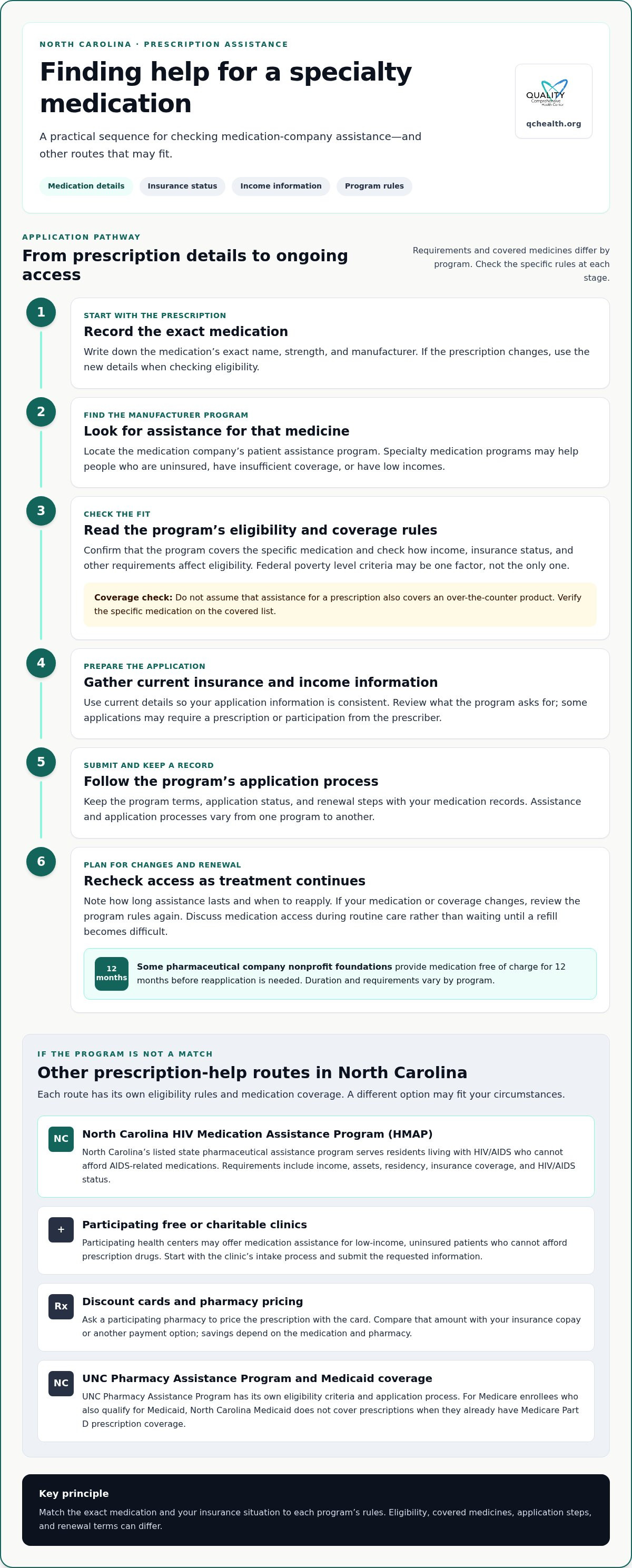
To apply directly, identify the medication’s manufacturer and its patient assistance program. Review the eligibility criteria, then submit the application with the requested information. The process may require a prescription or participation from the prescriber. Programs differ: one may cover a medication while excluding another, and income or insurance status may affect eligibility. Keep the program requirements and renewal date with your medication records.
Program Costs, Savings, and Medication Restrictions
Patients receiving medication through pharmaceutical company nonprofit foundations typically receive it free of charge for 12 months before needing to reapply. The medication and eligibility requirements vary by program, so confirm which prescription the foundation covers and how long assistance lasts. Discount cards may reduce a pharmacy’s price for eligible prescriptions, but the savings depend on the medication and participating pharmacy. Compare the card price with your available coverage before paying.
State pharmaceutical assistance programs (SPAPs) are another route, although eligibility and benefits differ by state. At least 48 states have an SPAP, while 13 states provide state discount programs. North Carolina’s listed SPAP is the North Carolina HIV Medication Assistance Program (HMAP). It assists residents living with HIV/AIDS who can’t afford AIDS-related medications. The North Carolina HIV Medication Assistance Program sets requirements for income, assets, residency, insurance coverage, and HIV/AIDS status.
The UNC Pharmacy Assistance Program has its own eligibility criteria and application process. Review its requirements to see whether it fits your situation. Don’t assume HMAP’s rules apply: HMAP is specifically for residents living with HIV/AIDS who need AIDS-related medication assistance.
For a pharmacy discount card, review its terms and find a participating pharmacy. Ask the pharmacy to price the prescription with the card, then compare the amount with your insurance copay or another payment option. A discount card is not the same as a medication assistance application, and its usefulness depends on the pharmacy and prescription.
To apply for a free pharmacy program, start with a participating free or charitable clinic that offers medication assistance. Follow its intake process and submit the requested application information. North Carolina medication assistance programs at participating health centers can help low-income, uninsured patients who can’t afford prescription drugs. The Coverys Community Healthcare Foundation invested $80,000 in faster medication access for uninsured North Carolinians.
Medication-company assistance for specialty drugs
High-cost specialty medication can strain household budgets, especially when insurance leaves a large coverage gap. Medication-company assistance programs may help people who are uninsured, have insufficient coverage for specialty medication, or have low incomes. For North Carolina residents, the first step is to match the medication and insurance situation to the program’s rules.
Start with the medication’s exact name, strength, and manufacturer. Find the manufacturer’s assistance program and review its eligibility requirements. Programs vary in who qualifies, which medications they cover, and how applications are handled. Gather current insurance and income information before applying so your answers are consistent. If a program excludes your medication or coverage type, another assistance route may fit better.
Specialty treatment often involves ongoing care, so consider how medication access fits into the full treatment plan. Keep a record of your application status, program terms, and renewal steps. If the medication changes, review eligibility using the new prescription details. If you’re managing a chronic condition, discuss medication access during routine care rather than waiting until a refill becomes difficult to obtain.
Donations can support broader efforts to improve access, though they are different from direct assistance to an individual. The Coverys Community Healthcare Foundation invested $80,000 in faster medication access for uninsured North Carolinians. That community investment illustrates how funding can advance access efforts; it doesn’t establish personal eligibility for a manufacturer program or guarantee help with a particular prescription.
Medicare Part D coverage is another factor to consider before treating assistance as wraparound support. North Carolina Medicaid doesn’t cover prescriptions for Medicare enrollees who also qualify for Medicaid when they already have Medicare Part D prescription coverage. Review how the existing plan handles the medication, then compare that coverage with the manufacturer program’s requirements. This distinction helps avoid assumptions about which benefit pays.
Free over-the-counter medication is a separate issue from help with prescribed specialty drugs. Don’t assume a program that covers prescription medication also covers an over-the-counter product. Check whether the specific medication appears on the program’s covered list and follow its application instructions. A pharmacist can help distinguish prescription from over-the-counter products, while a care team can discuss how each fits the treatment plan.
For people balancing complex treatment needs, keeping medication access connected to ongoing care can make next steps clearer. Explore support for complex health needs as you consider care alongside financial assistance.
Income eligibility based on the federal poverty level
Income rules vary among prescription assistance programs in North Carolina. Federal poverty level criteria can help programs assess need, but each program sets its own eligibility requirements.
Household Income Eligibility
Start by identifying how the program defines a household and what income information its application requests. Compare your household details with that program’s stated federal poverty level criteria instead of assuming one threshold applies everywhere. Gather income records and household information before applying. A manufacturer program, a clinic-based medication program, and a state program may assess applications differently.
For a practical review, note who the application counts as part of your household and which income sources it asks you to report. Follow the program’s instructions for calculating income. If it asks for household income, don’t substitute an individual figure without checking the wording. The program’s criteria determine how the federal poverty level applies to its decision.
Income isn’t the only consideration in every North Carolina program. HMAP eligibility also depends on assets, residency, insurance coverage, and HIV/AIDS status. Meeting an income criterion may not be enough to qualify. Review the full eligibility list and organize the requested information so you can address each requirement.
SPAP Eligibility
North Carolina’s listed state pharmaceutical assistance program is the North Carolina HIV Medication Assistance Program (HMAP). It helps residents living with HIV/AIDS who can’t afford AIDS-related medications, subject to requirements for income, assets, residency, insurance coverage, and HIV/AIDS status. Consider these criteria together: income alone doesn’t determine eligibility.
North Carolina Health Choice for Children serves uninsured children in low-income families who earn too much to qualify for Medicaid but can’t afford private or employer-provided health insurance. Eligible children may be able to get prescription medications through the program. Families considering this route should review the child’s insurance situation and the program’s eligibility requirements, not rely on household income alone.
Medication assistance programs at participating North Carolina health centers may also help low-income, uninsured patients who can’t afford prescription drugs. These programs are available through settings such as free and charitable clinics, rural health centers, and community health centers. Ask the participating clinic about its application process and required information. The North Carolina Office of Rural Health can refer people to a clinic, but it doesn’t provide patient care.
Keep each program’s name with its eligibility notes: HMAP, North Carolina Health Choice for Children, or a participating health-center program. This helps families avoid mixing up requirements and focus on the option that fits their circumstances.
Online patient assistance program locator
An online patient assistance locator can help North Carolina residents narrow their search by medication, insurance, and location. Treat the results as a starting point, then follow each program’s application instructions for next steps.
Begin with the exact medication name on the prescription label. Include its brand or generic name, and note the prescribing clinician and pharmacy. Search for the medication alongside terms such as “patient assistance program” or “manufacturer assistance.” If it’s a specialty medication, include its full name to avoid unrelated results.
When available, use a locator’s filters to add North Carolina, insurance status, and household income. These details can help distinguish manufacturer programs from clinic-based or condition-specific assistance. For example, searching for an HIV medication may surface information about HMAP, which serves eligible residents living with HIV/AIDS.
Compare each result with the medication and eligibility details you collected. Look for the program’s official name, the manufacturer or administering organization, covered medications, application steps, and renewal instructions. A result for one medicine doesn’t mean another prescription qualifies. Save the program name and the requirements that apply to your medication.
Search using the medication’s exact name and the phrase “patient assistance.”
Add North Carolina, insurance status, and household information to refine results.
Separate manufacturer programs from state or health-center assistance.
Follow the application instructions for the specific medication and program.
Record any renewal steps alongside the medication name.
For state and community options, search by the type of help you need. HMAP provides AIDS-related medication assistance, while North Carolina Health Choice for Children covers prescription medications for eligible uninsured children in low-income families. Participating health centers also offer medication assistance to low-income, uninsured patients. The North Carolina Office of Rural Health can refer people to clinics offering assistance.
Search results may also mention the federal 340B Program. According to the Health Resources and Services Administration, 340B provides discounts from participating manufacturers to certain types of health care facilities. That program describes facility discounts, so patients should distinguish it from an individual manufacturer assistance application.
Keep a simple comparison list for each option: covered medication, insurance and income criteria, application documents, and next step. For example, list HMAP separately from a manufacturer program because their eligibility rules and application routes differ. This helps you plan focused follow-up instead of submitting the same information to unrelated programs.
Online locators can organize your search, but the program’s own criteria guide the application. Use the exact medication name, North Carolina residency details, and insurance information to narrow a broad search to a relevant assistance route.
Does North Carolina Medicaid cover prescription drugs, and how can residents qualify?
Yes. North Carolina Medicaid provides prescription coverage through health insurance plans for eligible low-income parents, children, seniors, and disabled residents. Eligibility depends on meeting the requirements for a Medicaid category, and prescription coverage is provided through the health plan.
Start by identifying which group best describes your situation: parent, child, senior, or person with a disability. Review that category’s eligibility requirements and prepare accurate information about your household circumstances and current insurance. This helps you focus on the right application route instead of assuming income alone determines eligibility.
If you’re applying for a child, distinguish Medicaid from North Carolina Health Choice for Children. Health Choice serves uninsured children in low-income families who earn too much to qualify for Medicaid but can’t afford private or employer-provided health insurance. It provides their prescription medications free of charge. The programs serve different eligibility situations, so the child’s insurance and household circumstances matter.
Medicare coverage changes the prescription coverage picture for some residents. North Carolina Medicaid doesn’t cover prescriptions for Medicare enrollees who also qualify for Medicaid if they already have Medicare Part D prescription coverage. If you have both Medicare and Medicaid, identify your Part D coverage before comparing medication assistance options. Don’t assume Medicaid will pay for prescriptions in addition to an existing Part D plan.
To prepare an application, gather information about your household, income, age or disability status, and insurance coverage. Use it to review the appropriate Medicaid eligibility category and complete the application accurately. If you’re applying for a child, note whether the child has private or employer-provided insurance. If Medicare applies, include Part D coverage when reviewing prescription benefits.
Identify the Medicaid eligibility category that matches your circumstances.
Review household income and insurance details against that category’s requirements.
For a child, compare Medicaid with North Carolina Health Choice for Children.
For Medicare enrollees, account for existing Part D prescription coverage.
Medicaid is one of several prescription assistance programs in North Carolina. Residents who don’t fit a Medicaid category can also consider other routes discussed in this guide, such as manufacturer assistance or programs at participating health centers. The program’s intended population and your insurance status help determine which path to pursue.
If you need help connecting prescription coverage questions with ongoing health needs, discuss your care needs with a care team.
Quality Comprehensive Health Center: Specialty care
Quality Comprehensive Health Center offers specialty care as part of ongoing healthcare. If prescription costs affect your treatment decisions, connect your search for assistance with care for the condition involved. Primary Care & Internal Medicine supports general health needs, while Pediatric Care serves children and Behavioral Health & Counseling Services support mental health needs. These services are distinct from manufacturer assistance programs, which have their own eligibility rules and application processes. For complex conditions, specialty care can complement attention to treatment needs and available assistance options. Choose the care that fits your needs, whether specialty, primary, pediatric, or behavioral health services. Contact Quality Comprehensive Health Center to learn more or schedule care.
Take the Next Step Toward Care That Fits
Finding prescription assistance programs in NC is one part of caring for your health. Keep medication questions connected to the care you need so your treatment remains part of the conversation. Write down which medication is difficult to afford and what you want to discuss with a health professional.
Quality Comprehensive Health Center offers specialty care, primary care, and pediatric care. These services support different needs, from ongoing health concerns to care for children. If you’re looking for a place to discuss your health, connect with the appropriate care team.
Moving forward can start with one clear conversation. Contact Quality Comprehensive Health Center to take the next step toward care that fits your needs. You deserve support as you work toward better health.
Frequently Asked Questions
What Prescription Assistance is Available in North Carolina?
North Carolina residents can explore manufacturer assistance, Medicaid prescription coverage, and medication programs through participating health centers. Some options focus on specific populations or conditions, while manufacturer programs may be tied to a particular medication. Start with the prescription name and your insurance situation, then compare each program’s purpose and eligibility requirements. In Charlotte, Quality Comprehensive Health Center offers integrated care and support services for community members.
What prescription assistance programs are available to North Carolina residents?
Options include pharmaceutical company patient assistance, specialty medication programs, North Carolina Medicaid, and programs at participating health centers. HMAP serves eligible residents living with HIV/AIDS who need AIDS-related medications. North Carolina Health Choice for Children provides prescription medications for eligible uninsured children in low-income families. These programs serve different needs, so identify whether you’re seeking help for a specific prescription, a child, or a qualifying health condition.
Who qualifies for North Carolina prescription assistance programs, including income and residency requirements?
Eligibility depends on the program, not on one statewide income rule. Applications may consider federal poverty level criteria, household income, insurance, medication, or health condition. HMAP also considers assets, residency, and HIV/AIDS status. Health Choice for Children eligibility relates to a child’s uninsured status, family income, and access to private or employer-provided coverage. Review the specific program’s criteria before gathering application information.
How can North Carolina residents apply for prescription assistance programs, and what documents are required?
Start by identifying the medication and the program that covers it, then follow that program’s application process. Requirements differ, so there is no single document checklist for every application. Organize information that may affect eligibility, such as household income, insurance coverage, North Carolina residency, assets, and prescription details. For a manufacturer program, use the medication’s exact name to find the relevant application and requested materials.
Are there North Carolina programs that help seniors pay for prescription drugs, such as Medicare Extra Help or SHIIP?
Seniors can explore Medicare Extra Help and SHIIP alongside their existing prescription coverage. Compare the medication with the person’s Medicare Part D coverage before considering another assistance route. North Carolina Medicaid doesn’t cover prescriptions for Medicare enrollees who also qualify for Medicaid when they already have Medicare Part D prescription coverage. Keeping the medication list and current coverage information together can make this comparison clearer.
How can uninsured or underinsured North Carolina residents get low-cost or free prescription medications?
Uninsured or underinsured residents can explore manufacturer assistance, specialty medication programs, and medication assistance at participating health centers. Free and charitable clinics, rural health centers, and community health centers may help low-income, uninsured patients who can’t afford prescriptions. In Charlotte, start with the medication name and your insurance status, then identify a participating clinic or program that fits your circumstances.
Which prescription discount cards, pharmacy programs, or patient assistance programs are available in North Carolina?
Residents can compare manufacturer patient assistance programs, health-center medication assistance, and discount cards accepted at participating pharmacies. A discount card’s value depends on the prescription and pharmacy, so ask for the price with the card and compare it with your insurance copay. Manufacturer programs are different: each has its own medication and eligibility rules. Keep the card’s terms separate from any assistance application.
Where can North Carolina residents find local prescription assistance resources by county?
Search for participating free and charitable clinics, rural health centers, and community health centers serving your county. When using an online assistance locator, include your county and medication name, then separate local clinic options from manufacturer programs. The North Carolina Office of Rural Health can refer people to clinics offering medication assistance, but it doesn’t provide patient care. Charlotte residents can use the same approach to find local resources.



Comments