


Med Sync Services in Gastonia: Costs and Enrollment

A coordinated refill schedule can simplify medication routines, but medication synchronization services at Quality Comprehensive Health Center do not have one universal cost. Any added charge depends on the arrangement and prescription coverage; case-specific pricing is provided after a quote request for patients throughout Charlotte, NC, and the surrounding areas.
It makes sense to want fewer refill dates without facing an unexpected expense. Medication synchronization aligns eligible prescription refills around a shared pickup schedule. This can reduce separate pharmacy trips and make it easier to keep track of what is due.
This guide explains what may affect cost, who may benefit, and how enrollment generally works. You’ll also learn how coordinating refills can support medication routines and reduce the chance of missed or mixed-up doses, plus what to consider when deciding whether this approach fits your needs.
Key Takeaways
Learn what can affect whether coordinating refills adds a cost, without relying on a one-size-fits-all price.
See how aligning refill dates can make it easier to keep track of multiple prescriptions and reduce pharmacy trips.
Identify situations where a shared refill schedule may be useful, including difficulty managing refill dates or getting to the pharmacy.
Follow practical steps for discussing enrollment and organizing prescription information.
Understand why reviewing medications together can help spot possible interactions or duplicate prescriptions.
Table of Contents
Medication adherence
Medication adherence means taking each medicine as prescribed, including the correct dose and timing. A refill calendar can help, but it cannot replace the prescriber’s instructions. Medication synchronization brings refill dates together so several eligible prescriptions can be collected on a planned schedule. It organizes refills; it does not change how or when medicines should be taken.
That distinction matters for people managing chronic conditions with multiple prescriptions. Improved adherence and fewer medication errors may contribute to better health outcomes, especially when ongoing treatment involves several medicines. Receiving refills together may also reduce the chance of skipping a dose or taking the wrong medicine at the wrong time. Coordination supports the routine, while the prescribed directions remain the guide.
Consider someone whose blood pressure medicine and another long-term prescription run out on different dates. Tracking each refill separately can make it harder to remember which supply needs attention. With aligned refills, the person can plan around one pickup date. They must still follow each medicine’s label and instructions: a shared refill date does not mean taking the medicines together.
To make the schedule useful, build a simple routine around the refill date:
Keep a current list of prescription medicines, including each medicine’s name and the directions shown on its label.
Mark the coordinated refill date on a calendar, then review the list before pickup.
Separate refill reminders from dose reminders, so collecting medicine isn’t confused with taking it.
Tell the prescriber or pharmacist when a medicine has changed, stopped, or become difficult to take as directed.
For example, a calendar entry can remind you to collect refills, while a separate daily reminder follows the prescribed dosing schedule. Keeping these reminders distinct helps avoid treating the pickup date as a new dosing instruction. If a label is unclear, ask the healthcare professional responsible for the medicine to explain it before changing your routine.
Medication synchronization can support consistency, but it cannot solve every barrier. You may still need help understanding directions, remembering doses, or managing a treatment change. Naming the specific challenge helps the care team respond clearly. For instance, saying “I can collect my refills together, but I’m unsure which dose to take in the evening” identifies a dosing question that scheduling alone cannot answer.
Use the coordinated refill date as a regular opportunity to review what you have on hand and what has changed. Keep your medicine list accessible, follow each prescription’s directions, and raise questions about missed doses or confusing labels with a qualified healthcare professional. These steps make refill coordination a practical part of a careful medication routine.
Who can benefit from Medication Synchronization?
In Charlotte, pharmacies that offer medication synchronization can coordinate eligible prescription refills around a shared schedule. Ask your current pharmacy whether it provides this service and which prescriptions may be included.
Monthly Refill Alignment
Monthly alignment brings eligible prescription refills toward one planned pickup date. For example, if one medicine runs low before another, the pharmacy can review the refill timing and coordinate the schedule. Consider whether the proposed date fits each prescription’s timing and your routine. A shared date organizes collection, while each medicine keeps its own directions.
Coordinated Prescription Refill Dates
To synchronize dates, start with a current list of prescriptions and their refill dates. The pharmacy team can use it to plan a common pickup schedule for medicines that can be coordinated. Ask how the schedule works if a prescription changes or a refill date shifts. A calendar entry for the agreed pickup date can help keep the routine clear.
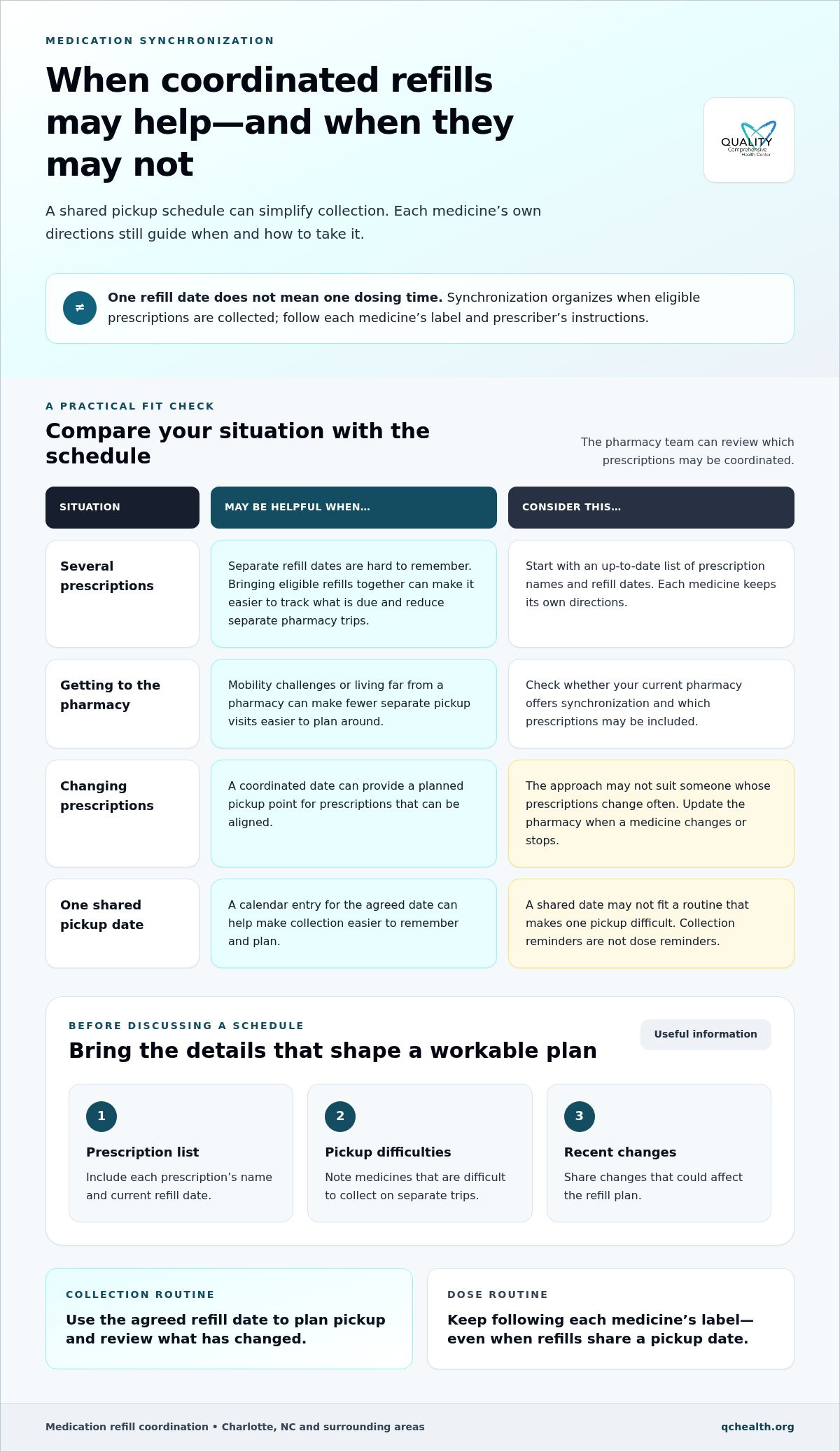
A coordinated schedule may help if separate refill dates are hard to remember. Someone taking several medicines for a chronic condition, for instance, may struggle to track which prescription needs renewal next. Bringing eligible refills together can reduce the need for multiple pharmacy trips each month. It may also make it easier to keep medicines on hand and reduce the chance of missed or mistimed doses.
It may also help people with mobility challenges or those who live far from a pharmacy. Fewer separate trips can be easier to plan around transportation, work, or caregiving. The approach may not suit someone whose prescriptions change often or whose routine makes one shared pickup date difficult. An up-to-date medication list gives the pharmacy a practical starting point.
Before discussing a schedule, gather prescription names and current refill dates. Then identify which dates are easy to remember and which create a problem. Include details such as:
Each prescription’s name and current refill date.
Medicines that are difficult to collect on separate trips.
Recent changes that may affect the refill plan.
Use that list to discuss a workable monthly date with the pharmacy team. The schedule should make collection simpler, not confuse pickup with dosing. Follow the label for each medicine, even when several refills share one date. If a prescription changes, update the list and calendar. For practical guidance on organizing care, explore healthcare support.
Eligibility and potential beneficiaries
Medication synchronization is most relevant when refill tasks create a practical challenge. Someone taking several prescriptions may struggle to remember which supply needs attention next. A person with limited mobility or a long trip to the pharmacy may also value fewer separate pickup visits. These circumstances can help determine whether one coordinated schedule could make refills easier to manage.
Start by looking at your refill routine rather than assuming a particular diagnosis qualifies you. Write down each prescription, its next refill date, and any recent changes. Then consider whether missed reminders, multiple pharmacy trips, or difficulty traveling make the process harder. For example, someone who relies on a family member for rides may prefer planning around one pickup rather than separate visits.
Daily support needs matter, too. A caregiver who helps organize prescriptions may use one shared refill date to plan errands and keep the medicine list current. Someone managing medicines independently may find one calendar entry easier to follow than several scattered dates. Either way, the schedule should support the person’s routine without replacing the directions for each medicine.
Several prescriptions have refill dates that are difficult to track.
Separate pharmacy visits create transportation or mobility challenges.
A caregiver helps coordinate pickups or maintain a medicine list.
Refill reminders are frequently missed or become confusing.
These signs indicate potential usefulness, not guaranteed eligibility. The prescriptions and their refill timing determine whether they can be placed on a shared schedule. A medicine recently changed by a prescriber, for instance, may need updated details before the refill calendar is planned. An accurate list makes those details easier to review.
Medication synchronization may be less helpful if one shared pickup date adds pressure or conflicts with your routine. If you cannot reliably travel on the planned date, consider what support would make pickup workable. A caregiver, transportation plan, or calendar reminder may help organize the task. The key question is whether the schedule reduces practical barriers rather than creating a new one.
To prepare for an enrollment conversation, gather prescription names, refill dates, and notes about recent changes. Include the specific challenge, such as forgetting which prescription runs out first or needing transportation help. This gives the pharmacy a clear picture of your routine and helps identify which refills can be coordinated. If you manage multiple prescriptions, have mobility limitations, or face long trips, these details can help you discuss whether a shared schedule fits your needs.
How to enroll
Begin by asking a pharmacy that offers medication synchronization how enrollment works. Have a current prescription list ready, including each medicine’s name and refill date. This gives the pharmacy team a starting point for reviewing which refills may fit a shared schedule. If a family member helps manage pickups, include them in planning the routine.
Use these steps to prepare for an enrollment discussion:
Write down each prescription and its current refill date.
Mark medicines that have recently changed or stopped.
Describe the refill challenge, such as missed reminders or difficult trips.
Discuss a practical monthly pickup date and how changes will be handled.
The pharmacy team can then review refill dates and identify a workable schedule for eligible medicines. Refills may not all be ready on the same day at first, so the initial schedule may involve timing adjustments. Ask which prescriptions can be aligned and what the planned pickup date means for each one. The schedule organizes refills; it does not change prescription directions.
For example, one refill may be due before another. The pharmacy can discuss how to bring the dates closer together while accounting for each prescription’s refill timing. Keep taking medicines as directed during any scheduling transition. Don’t skip doses or change how much you take to make supplies run out together. A refill calendar helps distinguish collection plans from daily dosing instructions.
Before finishing the enrollment conversation, make sure the next steps are clear. Write down the shared pickup date, the prescriptions included, and any medicines that remain on separate refill schedules. If a new prescription is added or a current one changes, update your medication list and tell the pharmacy team. This helps keep the refill plan aligned with your current treatment routine.
Some pharmacies may also provide medication counseling or reviews alongside synchronization. Use that conversation to ask practical questions, such as how to handle a changed prescription or what to do if a refill date no longer works. Keep contact information and your medication list together so they are easy to find when a change occurs.
Enrollment works best as a clear exchange: you share an accurate medication list and describe your routine, while the pharmacy explains the schedule and included refills. Before the first coordinated pickup, compare the plan with your prescriptions and note any uncertainties. Keep following each label and report changes promptly so the refill calendar remains useful.
Potential drug interactions and duplicate medications
Medication synchronization can make refill routines easier to organize and help you keep prescriptions on hand. A shared pickup date does not prove that medicines are compatible or that the list is current. Synchronization coordinates refills; it does not replace a medication review or prevent every interaction or duplicate prescription.
A complete medication list gives the pharmacy team a clearer view of what you take. Include prescription medicines, over-the-counter products, vitamins, and supplements. For example, a supplement started between refills may not appear on a prescription list unless you mention it. Names, strengths, and label directions help distinguish medicines that sound similar or have overlapping purposes.
Duplicate therapy can occur when a prescription changes but an older supply remains at home. You might keep both the previous and updated containers, then mistake them for separate medicines. Similar products from different prescribers can also be confusing. Don’t combine, stop, or discard medicines based only on a suspected duplicate. Share the labels and explain the situation during a medication review.
Interactions are another reason to review your full medication list. A pharmacist or prescriber can assess medicines together and explain any concerns. Pharmacies offering synchronization may also provide medication counseling and reviews. Mention new prescriptions, recent changes, supplements, and confusing directions. A coordinated refill calendar alone cannot show whether a treatment combination remains appropriate.
Before a review, gather the containers or a written list. Include details such as:
Prescription and nonprescription product names.
Directions shown on each label.
Medicines recently started, changed, or stopped.
Questions about overlapping names, purposes, or instructions.
Then compare the review notes with the prescriptions you collect. If a label differs from the instructions you remember, pause before changing your routine and ask the responsible healthcare professional to clarify it. Keep the updated list with your refill calendar so a caregiver or another member of your care team can understand the current plan.
Medication synchronization works best alongside clear communication about treatment changes. Tell the pharmacy team when a prescriber adds or adjusts a medicine, rather than relying on the next shared refill date to communicate that change. For support organizing a medication safety conversation, discuss your medication list with a healthcare professional.
Quality Comprehensive Health Center: Specialty care
Quality Comprehensive Health Center provides specialty care in Charlotte for people whose health needs call for focused clinical support. If medication questions connect to a broader health concern, Primary Care & Internal Medicine can address that concern as part of ongoing care. Pediatric Care and Behavioral Health & Counseling Services are also available for patients and families whose needs fit those areas.
Bring a current medication list and note questions about treatment, refill routines, or changes in your health. These details can help guide a conversation with a healthcare professional and clarify what support is appropriate. Call Quality Comprehensive Health Center or visit qchealth.org to learn more.
Make Your Next Medication Conversation Count
Your next step can be small and practical: bring a current medication list and write down the questions you want answered. For anyone considering medication synchronization services in Charlotte, that preparation can help make a conversation about refill routines more focused. Note what feels difficult today, such as keeping track of changes or planning pickup around daily responsibilities.
Quality Comprehensive Health Center offers specialty care, primary care, and pediatric care. These services can support people seeking care for broader health needs alongside questions about medication routines. The right conversation begins with what matters to you and the support you’re looking for.
Contact Quality Comprehensive Health Center to take the next step. A clearer plan can start with one thoughtful question and a medication list you feel ready to discuss.
Frequently Asked Questions
Does med sync cost extra?
There is no standard answer about an added synchronization charge. The cost depends on the arrangement and prescriptions involved, and case-specific pricing is provided after a quote request. Keep any coordination charge separate from what you may owe for the medicines themselves. Before choosing a schedule, ask for a clear explanation of service charges and how prescription costs are handled.
How does Med Sync work?
Medication synchronization coordinates eligible prescription refills around a shared pickup date. The pharmacy reviews the prescriptions and their refill timing, then works out a schedule. For example, a refill due earlier may need its timing adjusted to align with another prescription. The process organizes collection, not dosing, so keep following each medicine’s label and instructions throughout.
How does medication synchronization work at Gastonia pharmacies?
In Gastonia, medication synchronization is available through pharmacies that offer the service. Ask your current pharmacy whether it provides it. If so, bring a current list of prescriptions and their refill dates. The pharmacy can review which medicines may be coordinated and explain the proposed schedule. Keep a written record of the agreed pickup date and included prescriptions.
What are the eligibility requirements for medication synchronization?
Eligibility rules vary by pharmacy program. The pharmacy reviews prescriptions and refill timing to determine which medicines can be aligned. Someone taking several ongoing prescriptions may have a practical reason to ask, especially if separate dates are difficult to manage. A current medication list helps the pharmacy assess the schedule without relying on memory alone.
How much does medication synchronization cost in Gastonia?
There is no standard cost for medication synchronization in Gastonia. Case-specific pricing is provided after a quote request, and the amount depends on the arrangement and prescriptions involved. Keep the synchronization charge separate from prescription costs, which depend on the medicines and coverage. Ask for a clear breakdown of costs for the refills and the coordination service.
Does insurance cover medication synchronization services?
Insurance coverage for prescription medicines and any synchronization charge are separate questions. A plan’s drug benefits determine how covered prescriptions are paid for, while a coordination fee may be handled differently. Review your plan’s pharmacy benefits and the details of the synchronization service. A covered prescription does not automatically mean a separate coordination charge is covered.
How do I enroll in a medication synchronization program in Gastonia?
Ask a Gastonia pharmacy that offers the program how to start enrollment. Prepare a current prescription list, refill dates, and notes about medicines that changed or stopped. Then discuss which prescriptions can be coordinated and the proposed pickup schedule. Before enrolling, make sure you understand which medicines are included and how to report future prescription changes.
Can medication synchronization coordinate prescriptions from multiple doctors or pharmacies?
Prescriptions from multiple doctors can be reviewed together when you provide a complete, current list. Prescriptions filled at multiple pharmacies may require extra coordination, since each pharmacy needs accurate information about the medicines it handles. Bring the names of the prescribers and pharmacies to the enrollment discussion. This helps clarify which prescriptions can be included in one schedule and what steps may be needed.


Comments