


How Gastonia prescription discount programs work

A prescription discount card can help you compare medication costs at nearby pharmacies, but it isn’t insurance. For Gastonia residents, comparing current prices may offer another way to manage out-of-pocket prescription costs.
Medication costs can be difficult to manage, especially during a gap in insurance coverage. A discount card or app may help you find a lower price, but it’s important to understand how the program works and how it differs from your insurance benefits.
Learn how to use discount cards and apps, what to consider when comparing programs, and how to manage prescription costs during an insurance gap. You’ll also find practical guidance on comparing a discount price with your available coverage so you can make an informed choice about your care.
Table of Contents
How Do Prescription Discount Programs Work?
A prescription discount program helps people compare prescription medication prices at participating pharmacies. A discount card or app offers a price for a particular prescription, but it isn’t insurance. The price can vary by medication, pharmacy, quantity, and current offer. A discount that helps with one prescription may not lower the price of another.
Charlotte residents can compare pharmacy prices using a discount card and North Carolina’s discounted medication documents. The Centers for Medicare & Medicaid Services lists 800-633-4227 for Medicare and Medicaid prescription-cost questions. TTY callers can use 877-486-2048, according to the Centers for Medicare & Medicaid Services.
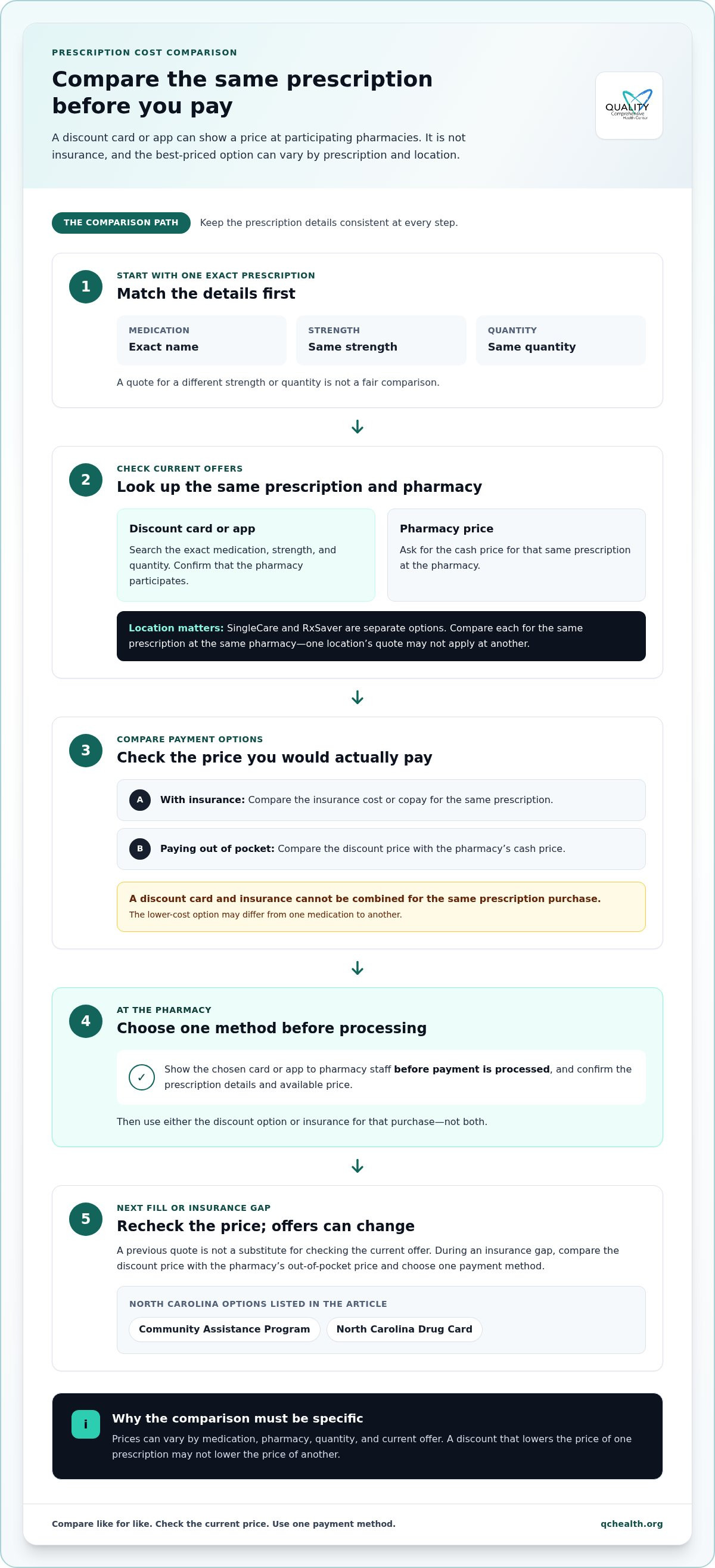
Compare prices before filling a prescription. Start with the exact medication name, strength, and quantity on the prescription. Then ask pharmacies for the cash price and compare it with the card or app price for that same prescription. For example, compare the price for the same quantity at two pharmacies, not different quantities or strengths. This gives you a clearer picture of which option costs less at that time.
Use these steps to make the comparison useful:
Check the prescription details, including the medication name, strength, and quantity.
Search the card or app for that exact prescription and review participating pharmacies.
Compare the displayed price with the pharmacy’s cash price and your insurance cost.
Choose one payment method before the pharmacy processes the prescription.
Prices can change, so compare again when you refill. A previous price isn’t a substitute for checking the current offer.
Pharmaceutical company patient assistance programs are another option to explore. Some companies provide assistance for their own medications through programs with separate applications and eligibility requirements. Identify the drug’s manufacturer, then look for its patient assistance program and review the terms. These programs are separate from discount cards, so compare what each option covers for your prescription.
Insurance and discount cards generally aren’t used together for the same prescription purchase. Compare your insurance price with the discount price, then use the option that costs less at checkout. A prescription discount card may help if you’re paying out of pocket, but it doesn’t replace insurance coverage. Compare the specific medication price and participating pharmacy instead of relying on a card’s general savings claims.
Using a discount card or app at the pharmacy
Use the same prescription details each time you compare a discount card or app. Have the medication name, strength, and quantity ready. Search for that exact prescription, then note the displayed price and participating pharmacy. A quote for a different strength or quantity won’t provide a fair comparison. Before pickup, show the card or app to pharmacy staff and ask them to process the discount price.
Compare SingleCare and RxSaver as separate options. Search each program for the same medication and pharmacy, then compare the prices. Don’t assume a price shown for one Gastonia location applies at another. The pharmacy must accept the particular program, and prices can differ by medication and location. For example, compare SingleCare and RxSaver quotes for one prescription at the same pharmacy, rather than comparing quotes from different locations.
Use one payment method for the prescription at checkout. A discount card and insurance aren’t combined for the same purchase. Ask the pharmacy to show the available price before processing payment, then decide whether to use insurance or the discount. Keep the card or app accessible, and confirm the prescription details before presenting it. This sequence can help you avoid choosing a price for the wrong medication, strength, or quantity.
To compare pharmacies in Gastonia, search for the exact pharmacy name with the city to find its current address. For nearby options, use your starting address and compare the route distance to each pharmacy. Then check the price for the same prescription at both locations. Distance alone doesn’t show which option costs less, so consider travel and medication price together. Don’t rely on an old address or saved quote when planning a new pickup.
Use this checklist before you leave home:
Match the medication, strength, and quantity on each search.
Compare SingleCare and RxSaver separately at the same pharmacy.
Check the pharmacy address and route from your starting point.
Show your chosen card or app before payment is processed.
For a medication question connected to care, explore pharmacy support as part of your next step.
Using discount cards during insurance gaps
Gastonia residents can consider the Community Assistance Program and North Carolina Drug Card, listed on North Carolina’s prescription discount page. Discount cards can help during an insurance gap, but they can’t be combined with insurance for a single prescription purchase.
Comparing Cards With Insurance Copays
Compare the card price with your insurance copay for the same prescription. Confirm that both prices match the medication, strength, and quantity. A discount card may cost less for one prescription, while insurance may be the better option for another. During a coverage gap, compare the card price with the pharmacy’s out-of-pocket price. Choose one payment method at checkout, not both.
How Prescription Discount Cards Work
A prescription drug discount card gives the pharmacy information to apply a program price to an eligible prescription. You can present a physical card or show the card details from an app. Search for the exact medication and pharmacy before filling it, then compare the displayed amount with your other payment options. Prescription discount cards can save customers up to 80%, though the available discount depends on the prescription and participating pharmacy.
Free Cards and Gastonia Program Options
Some prescription discount cards are available without a membership fee. North Carolina’s page lists the Community Assistance Program and North Carolina Drug Card as options. Compare the medication price and pharmacy participation for each program. A free card may not offer the lowest price for every prescription, so compare the specific offer before paying.
When insurance ends or pauses, list your current prescription drugs and their strengths. Use that list to compare card prices across pharmacies before requesting a refill. If a medication comes in several forms or strengths, search for the exact version on the prescription. A lower price for a different formulation may not apply to the prescription you need.
Tell pharmacy staff you want to use a discount card before the transaction is processed. Show the card or app, confirm the medication and quantity, and ask for the total using that option. If you have insurance, compare its copay separately. After the pharmacy processes the prescription, switching payment methods may require staff to reverse and reprocess the transaction.
Keep a note of which card gave you the best price for each prescription. A card that helps with one drug may not help with another, and prices can vary between pharmacies. For ongoing prescriptions, compare again at refill time. Keeping a record can help you choose how to pay during an insurance gap.
Discount card limitations and safety
A discount card can reduce a prescription’s purchase price, but it doesn’t determine which treatment is medically appropriate. Compare the card price for the prescribed medication without changing its strength, dose, or schedule yourself. If a medication seems unaffordable, raise the cost concern with the clinician managing your treatment. That keeps the discussion focused on safe options and your actual prescription.
Discount offers may apply only to particular medications, quantities, or pharmacies. A card’s advertised savings may not match the price for your prescription at a specific location. For example, an offer for one strength doesn’t establish the price of another. Review the exact drug name and prescription details before relying on a displayed discount. At the pharmacy, confirm that the price applies to the prescription being filled.
Generic medications can be another cost comparison to discuss with a prescriber or pharmacist. According to the FDA, generic drugs are equally as effective as non-generic drugs. In the United States, generic and brand-name medications must have the same active ingredients, safety and effectiveness, strength, dosage and administration, and quality and manufacturing. Generic versions may differ in characteristics such as color or flavoring without affecting effectiveness. Ask whether a generic is appropriate for your prescription instead of substituting one on your own.
Keep the discount card separate from decisions about treatment. A lower displayed price doesn’t mean a medication is suitable for every person or condition. If you’re considering a different medication because of cost, discuss your reason and options with the healthcare professional overseeing your care. Share the medication name and the price you found to support a focused conversation.
Before using a discount card, review how the program applies the offer. Confirm the pharmacy, medication, quantity, and price shown for that transaction. If a price changes between searches, compare the current details instead of relying on a saved screenshot. Keep your prescription information accurate, and don’t treat a discount card as a substitute for insurance coverage or clinical guidance.
If affordability remains a barrier, look beyond the card itself. Pharmaceutical company patient assistance programs may offer support for specific medications, with their own applications and eligibility requirements. Identify the manufacturer and review the program’s terms for the prescribed drug. Assistance programs differ from discount offers, so compare what each covers before deciding.
Use the card price only for the medication and pharmacy shown.
Discuss generic options with a prescriber or pharmacist.
Bring cost concerns and assistance questions into your treatment conversation.
Choosing a discount program
Choose a program by comparing its price for your prescription, not its general savings message. North Carolina lists the Community Assistance Program and North Carolina Drug Card as prescription discount options. Check whether each program covers your medication and can be used at a convenient pharmacy. The best fit depends on the prescription and the specific offer.
Start with the medication details on your prescription. Search each program for the exact drug, strength, and quantity. Then compare the displayed prices at the same pharmacy. If one program shows a coupon for a different strength, it isn’t a like-for-like comparison. Save the results with the medication details and pharmacy name so you can review the options clearly.
Review a program’s terms before using a card or coupon. Check for membership requirements, how to present the discount, participating pharmacies, and how the offer applies to your prescription. These details help you understand what you’ll need at checkout. If a term is unclear, use the program’s own information rather than assuming the discount works like insurance.
Consider how you’ll use the program. A physical card may suit someone who prefers a printed option, while an app can make searching and saving prices easier. Either way, keep the medication name, strength, and quantity consistent when comparing. If you use coupons from more than one program, label or save each result with the program name and pharmacy.
For example, compare the Community Assistance Program and North Carolina Drug Card using one prescribed medication and one pharmacy. Note which result applies to the exact prescription, what steps the program requires, and whether the pharmacy participates. Repeat the comparison for another medication instead of assuming one card offers the same benefit for every prescription.
Match the medication, strength, and quantity.
Compare options at the same pharmacy.
Review membership terms and redemption steps.
Keep each coupon or card result clearly identified.
A discount card is one part of managing prescription costs. If affordability concerns are affecting your emotional well-being, connect with behavioral health support as part of your care.
Quality Comprehensive Health Center: Specialty care
Quality Comprehensive Health Center offers specialty care in Charlotte for people who need support beyond routine health concerns. If prescription costs make it harder to manage a condition, talk with a healthcare professional about your care needs and treatment questions. Your next step may be to discuss medication concerns as part of primary or specialty care.
Care needs can affect the whole family. Quality Comprehensive Health Center also offers pediatric care and behavioral health services for children and adults with different health needs. A discount card can help compare medication prices, while a care team can address health questions a discount program can’t resolve.
For compassionate, coordinated support, contact Quality Comprehensive Health Center or visit qchealth.org.
Make medication affordability part of your care plan
Medication affordability deserves an ongoing conversation, not just a one-time search. As your prescriptions or coverage change, raise cost concerns when discussing your health goals and treatment. This can connect practical decisions about a discount prescription program in Gastonia with the care you need to stay well.
Quality Comprehensive Health Center offers specialty care, primary care, and pediatric care in Charlotte. These services can support individuals and families as their health needs change. A clinician can discuss your care needs alongside questions about prescribed treatment, making cost concerns part of a broader health conversation.
Take the next step when you’re ready. Contact Quality Comprehensive Health Center to connect with the care team and move forward with support.
Frequently Asked Questions
Which Prescription Discount Card Saves The Most Money?
No single prescription discount card saves the most on every medication. The lowest offer depends on the drug, its prescribed strength and quantity, and the pharmacy. Compare the same prescription across programs and locations. For example, a card that offers a better price on one medicine may offer less savings on another. Choose based on the current price for your prescription, not a general savings claim.
How much can prescription discount programs save on common medications in Gastonia?
Savings depend on the medication, pharmacy, and program offer, so there isn’t one price for common prescriptions in Gastonia. A discount prescription program in Gastonia may show different prices for the same drug at different pharmacies. For a useful comparison, search using the prescribed medication, strength, and quantity. Then consider the displayed price alongside any insurance copay or pharmacy cash price for that exact prescription.
How do I compare prescription prices at pharmacies near Gastonia?
Compare quotes for the same medication details at pharmacies you can reasonably reach from home, work, or another regular stop. Search for the exact drug name, strength, and quantity, then record the pharmacy and quoted price. If two pharmacies show different offers, compare the travel involved alongside the prescription price. Repeating the search at refill time helps account for changes to the offer or your prescription.
Can uninsured and insured patients use prescription discount cards in Gastonia?
People with and without insurance can compare a discount card’s price for a prescription. The difference is which other payment options are available: someone with insurance can compare the card price with their coverage, while someone without insurance can compare it with the pharmacy’s cash price. The pharmacy must accept the discount program. In either case, compare the exact medication and prescription details before choosing how to pay.
Can a prescription discount card be combined with health insurance or Medicare in North Carolina?
No. A prescription discount card can’t be used at the same time as insurance for one purchase. This applies when comparing a discount offer with health insurance or Medicare coverage. Look at the available price under each option, then select one payment method for that transaction. If you have questions about Medicare prescription costs, the Centers for Medicare & Medicaid Services lists 800-633-4227 for assistance.
Are there free prescription assistance programs for low-income residents of Gaston County?
North Carolina lists the Community Assistance Program and North Carolina Drug Card as prescription discount card options. Pharmaceutical company patient assistance programs may also support specific medications, with their own applications and eligibility requirements. These options are distinct, so identify the medication first and review the terms of each relevant program. Income alone doesn’t establish eligibility for every assistance program.
How do I use a prescription discount coupon at a Gastonia pharmacy?
Open the coupon or card information before the pharmacy processes your prescription. Match the medication, strength, and quantity to the prescription being filled, then show the coupon details to pharmacy staff. Confirm that the amount applies to that exact purchase before paying. If the information is saved on your phone, keep it available at checkout. A screenshot can help you find the offer, but use coupon details the pharmacy can process.
Are there eligibility requirements or fees for prescription discount programs in Gastonia?
Requirements and fees depend on the program. Review its terms for membership conditions, eligible medications, participating pharmacies, and how to redeem the discount. Manufacturer patient assistance programs may have separate applications and eligibility rules. Don’t assume one program’s conditions apply to another. Before relying on an offer, compare the program’s terms with the prescription you need and the pharmacy where you plan to fill it.



Comments