


HIV testing in Charlotte, NC: Prices and STD panel options

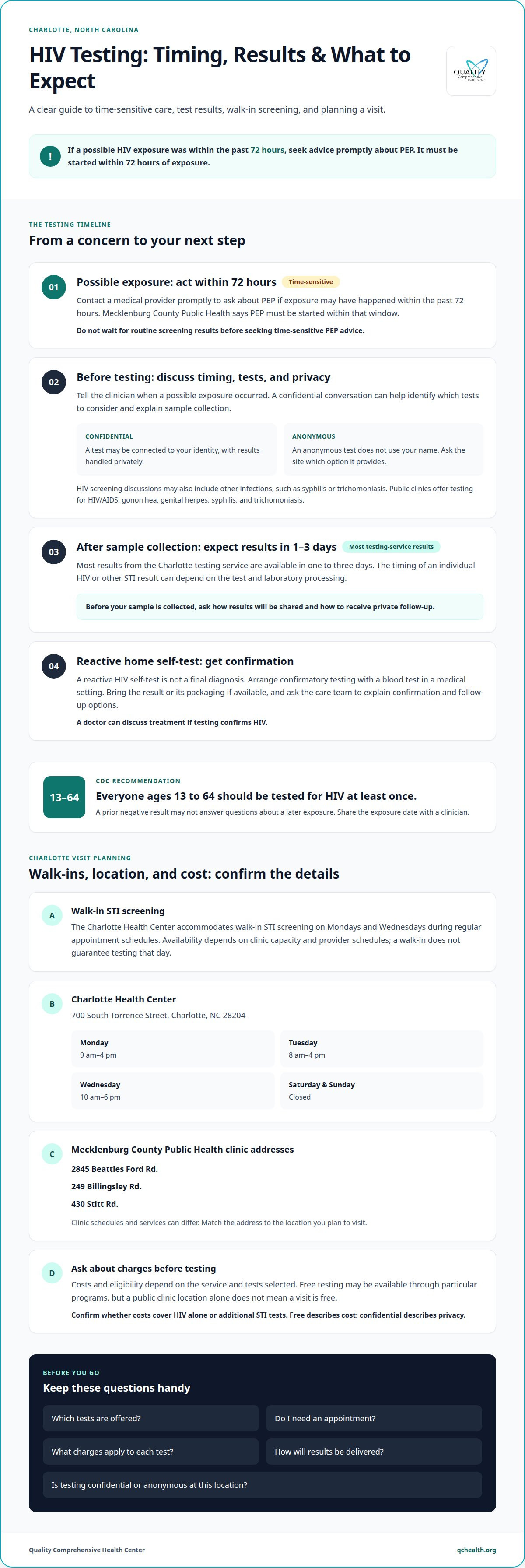
Timing matters after a possible HIV exposure. For HIV testing in Charlotte, NC, most results from the testing service are available in one to three days. If exposure may have happened within the past 72 hours, Mecklenburg County Public Health advises seeking advice promptly about PEP, which must be started within 72 hours of exposure.
It’s understandable to want clear answers about HIV testing in Charlotte, NC, including cost, walk-ins, and which tests to consider. Knowing what to expect can make the next step feel more manageable and help you focus on care rather than uncertainty.
This guide explains HIV testing and STD panel options in Charlotte, what can affect pricing, how walk-in screening works, and when results may arrive. It also covers what to do after a reactive self-test and how to find care that supports your health with respect and compassion.
Table of Contents
How long do STD test results take in Charlotte, NC?
Most results from the Charlotte testing service are available in one to three days. Timing for an individual HIV or other STI result can depend on the test and laboratory processing. Ask how results will be shared before your sample is collected, so you know what to expect and how to receive private follow-up.
For HIV testing in Charlotte, NC, screening can begin with a confidential conversation about your concerns and the test you need. A clinician or counselor can discuss HIV prevention, explain sample collection, and help you consider screening for other infections. Depending on your situation, that discussion may include testing for syphilis or trichomoniasis.
Confidential and anonymous testing are different. A confidential test may be connected to your identity, with results handled privately; an anonymous test does not use your name. Before testing in North Carolina, ask which option the site provides. It is also useful to understand privacy procedures and how results are delivered.
Everyone ages 13 to 64 years should be tested for HIV at least once, according to the Centers for Disease Control and Prevention. If you have a new concern, a prior negative result may not answer questions about a later exposure. Tell the clinician when the possible exposure occurred; that detail can help guide the next testing step.
If a home HIV self-test gives a positive result, arrange confirmatory testing with a blood test in a medical setting. A self-test is not a final diagnosis. Bring the result or its packaging if available, and ask the care team to explain confirmation and follow-up options. A doctor can discuss treatment if testing confirms HIV.
Exposure timing matters for prevention. If you may have been exposed to HIV within the previous 72 hours, seek advice promptly about PEP. Mecklenburg County Public Health says PEP must be started within 72 hours of exposure. Don’t wait for routine screening results before seeking that time-sensitive advice.
Free and confidential HIV/STI testing are separate considerations: free describes cost, while confidential describes privacy. When seeking a no-cost option, ask about charges for each test and whether results are confidential or anonymous. For walk-in HIV testing, first learn the site’s arrival process and screening availability. Walk-in access does not establish whether testing is free or anonymous, so clarify both before sample collection.
After testing, follow the instructions for receiving results and return for recommended follow-up. A negative result can be reassuring, but a clinician may consider the exposure date when discussing whether additional testing is appropriate. Confidential counseling can help you understand prevention choices and plan your next step without judgment.
Finding HIV testing locations in Mecklenburg County
You can get an HIV test at Mecklenburg County Public Health clinics and Charlotte testing locations. Mecklenburg County Public Health has a clinic at 2845 Beatties Ford Rd. Other listed clinic addresses include 249 Billingsley Rd. and 430 Stitt Rd. The Charlotte Health Center is at 700 South Torrence Street, Charlotte, in ZIP code 28204.
For a public option, identify the closest Mecklenburg County Public Health clinic. The clinics offer testing for HIV/AIDS and several other infections, including gonorrhea, genital herpes, syphilis, and trichomoniasis. A screening conversation can help you understand which tests fit your concerns. When you call or arrive, name the infections you want to discuss and ask how registration works.
Public clinics can be a practical place to ask about lower-cost testing. Costs and eligibility depend on the service and tests selected, so ask about charges before sample collection. Free testing may be available through particular programs, but a public clinic location alone does not mean a visit is free. Clarify whether the options cover HIV alone or include additional STI testing.
The Charlotte Health Center’s listed hours are Monday, 9 am to 4 pm; Tuesday, 8 am to 4 pm; and Wednesday, 10 am to 6 pm. It is closed Saturday and Sunday. These hours can help you plan travel, but they don’t describe every Mecklenburg County clinic’s schedule. Match the address to the clinic you intend to visit before setting out.
To choose a location, consider your travel route, the infections you want to detect, and whether you need a walk-in visit or an appointment. The Charlotte Health Center and Mecklenburg County Public Health clinics are distinct locations. Keep the full street address handy, especially if using a map or arranging transportation. If your concern follows a possible exposure within 72 hours, seek prompt medical advice rather than waiting for a routine screening visit.
Before leaving home, prepare a short list of questions: which tests are offered, whether the visit requires an appointment, what the costs are, and how results are delivered. This helps you compare public and other Charlotte options without assuming they provide the same services. If testing brings stress or difficult feelings, behavioral health support can be part of caring for your overall well-being.
Same-day testing and walk-in procedures
Walk-in STI screening at the Charlotte Health Center is accommodated on Mondays and Wednesdays during regular appointment schedules. Walk-in access depends on clinic capacity and provider schedules, so arriving without an appointment doesn’t ensure testing that day. The center is at 700 South Torrence Street in Charlotte. If you’re coming from South Charlotte, plan your route to that address rather than assuming a walk-in site is nearby.
Before leaving, call the testing location to ask whether it can accommodate walk-ins that day. The available facts don’t provide a phone number, so use the clinic’s own contact information. Ask whether HIV testing is included, whether other STI tests are available, and what time to arrive. This short check helps you distinguish same-day walk-in screening from a scheduled appointment.
For a planned visit, request an appointment and explain which tests you want to discuss. Mention symptoms, a possible exposure, or a partner’s diagnosis. These details can help the care team understand your concern and consider appropriate screening. For example, a request for chlamydia and gonorrhea testing differs from a question about hepatitis screening.
At the Charlotte Health Center, walk-in STI screening is accommodated only on Mondays and Wednesdays within regular appointment schedules. The center’s listed hours are 9 am to 4 pm Monday and 10 am to 6 pm Wednesday. Capacity and provider schedules still affect access. Tuesday hours are 8 am to 4 pm, but the walk-in screening information applies to Mondays and Wednesdays, not Tuesday.
Use this simple plan before a walk-in visit:
Choose the Charlotte Health Center or another Mecklenburg County clinic.
Call the location using its published contact details to ask about that day’s walk-in capacity.
Name HIV testing and any additional STI concerns, such as chlamydia or gonorrhea.
Follow the clinic’s instructions for sample collection and arrival.
Some urine testing has a preparation step. For chlamydia or gonorrhea urine tests at the Charlotte Health Center, avoid urinating or having sexual intercourse for one hour before testing. Plan ahead and tell clinic staff if this may affect your visit. This instruction applies to those urine tests, not automatically to every HIV test.
A same-day visit and same-day results are different. Walk-in screening describes how you may access testing; result timing depends on the test and processing. If you need an appointment, schedule through the location’s own process and share any time-sensitive concern. If you have symptoms, explain them clearly rather than waiting for a routine screening visit.
Appointment and testing information phone numbers
The Charlotte Health Center is open Monday from 9 am to 4 pm, Tuesday from 8 am to 4 pm, and Wednesday from 10 am to 6 pm. It is closed Saturday and Sunday. Walk-in STI screening is accommodated on Mondays and Wednesdays during regular appointment schedules, subject to clinic capacity and provider schedules.
For HIV testing in Charlotte, use the health center’s published contact information to ask about appointment options. The available clinic details identify its address and hours, but provide no phone number to print here. Use the center’s own current listing rather than relying on a number copied from an old directory. Ask whether the visit is scheduled, walk-in, or both.
A call can help you explain what you need before traveling to the clinic. Say whether you want HIV screening alone or want to discuss other sexually transmitted infections. If a partner tested positive or you may have been exposed, share that with staff. This can help them understand the reason for your appointment.
Keep your questions focused. Ask how to book, what arrival time to plan for, and whether the clinic is accommodating walk-ins that day. Also ask how testing is arranged and how results are delivered. These questions help clarify the difference between an appointment and walk-in access, which depends on the clinic’s capacity and provider schedule.
Before calling, note the Charlotte Health Center’s address: 700 South Torrence Street, ZIP code 28204. Having the location in front of you can prevent confusion with other Mecklenburg County clinics. If you need to reschedule, use the same official contact listing and give the staff enough information to identify your appointment.
Say whether you need HIV testing or broader STI screening.
Mention symptoms, a possible exposure, or a partner’s positive result.
Ask about appointment scheduling and current walk-in access.
Confirm the clinic address and the day’s listed hours.
Ask how results and any follow-up instructions are shared.
Be specific about timing if you may have been exposed recently. If the exposure may have occurred within the previous 72 hours, seek advice promptly about PEP rather than waiting for a routine appointment. For other concerns, such as sexually transmitted infection screening without urgent symptoms, the clinic’s appointment process can help you plan a visit around its listed hours.
Clear information supports a smoother visit. A scheduled appointment gives the clinic a planned time for your care, while a walk-in request depends on capacity. Use the official contact details for the Charlotte Health Center, and keep its Monday-through-Wednesday schedule nearby when planning your call.
HIV test pricing and STD panel options
Testing costs vary with the tests selected, whether you choose individual tests or a panel, and how results are released. The price depends on the case and is given after a quote request; cost factors include the infections tested, panel selection, and individual result options. Compare what each option includes, not just its label.
A standard STD panel can include HIV testing alongside other screening. The Charlotte testing service’s Standard STD Panel includes HIV 1 and 2 testing. A Full STD Panel is another option, but panel names alone don’t explain which infections are included. Ask for the test list before choosing, especially if you want chlamydia screening or have a specific concern.
Individual tests may suit someone seeking one result, while a panel can cover several infections in one visit. The right mix depends on the exposure, symptoms, and tests being considered. For example, if you are concerned about chlamydia, ask whether the selected panel includes it. A care provider can explain the tests and sample types involved.
Home self-test kits offer another way to collect a sample. Mecklenburg County’s Standard 5 Self-Test Kit tests for chlamydia, gonorrhea, trichomoniasis, HIV, and syphilis. The kit’s name describes its five infections, not whether it is free. If you’re looking for a free STI and HIV kit, ask about the specific program, which tests it includes, and how follow-up works.
For an HIV self-test, follow the kit instructions closely and read the result within the stated time. A positive self-test needs confirmation with a blood test in a medical setting. A home result is a screening result, not a final diagnosis. Arrange clinical follow-up so a professional can explain confirmation and next steps.
Window periods affect how soon a test can detect an infection after exposure. A negative result can be a false negative if testing happens before the infection is detectable. The timing depends on the test and the exposure date, so share both with your care provider. If you’re sexually active and have a new concern, explain what happened and when.
Before selecting a panel or home kit, use this checklist:
Identify the infection or infections you want tested.
Compare the included tests, not just the panel name.
Check whether the kit is free and how samples are handled.
Plan follow-up for a positive result or an early negative test.
Clear panel details help you choose a test path that fits your concern. If you have an active genital symptom or a partner’s positive result, include that information when discussing screening. It can help guide which tests to consider and whether follow-up testing is needed.
Quality Comprehensive Health Center: Specialty care
Quality Comprehensive Health Center can support broader health needs alongside HIV testing in Charlotte. Its primary care and specialty care services offer options for ongoing care when you need help with another health concern. Pediatric care is available for children and adolescents, while behavioral health services can support emotional well-being during a stressful period.
Turn to these services when you need care beyond arranging a test, such as support for a separate health concern or help managing anxiety around results. For HIV-specific testing, treatment, or follow-up, follow the clinical guidance provided by the testing service or your medical provider.
For information about care at Quality Comprehensive Health Center, visit qchealth.org.
Take your next step toward confident care
Choosing HIV testing in Charlotte, NC can be a starting point for a broader conversation about your health. Bring your questions, concerns, and priorities to a care visit, and use that discussion to decide what support makes sense for you. If you need care beyond screening, Quality Comprehensive Health Center offers specialty care, primary care, and pediatric care. These services can help individuals and families address other health needs as they move forward.
Your next step doesn’t need to answer every question at once. Start with the concern that matters most today, then discuss what ongoing care could look like. For information about available services, contact Quality Comprehensive Health Center. You deserve respectful care and a clear path forward.
Frequently Asked Questions
How Soon Should I Get Tested?
Seek advice promptly after a possible exposure, especially if it happened within the previous 72 hours. Mecklenburg County Public Health says PEP must start within 72 hours of exposure. For routine screening, the Centers for Disease Control and Prevention recommends that everyone ages 13 to 64 years get tested for HIV at least once. The right timing for follow-up testing depends on the exposure date and test used.
How long do STD tests take?
Most results from the Charlotte testing service are available in one to three days. That describes result timing, not necessarily the length of your visit. The time needed for collection depends on the tests selected and the clinic’s process. Before testing, ask how results will be delivered and whether the clinic will contact you about follow-up. Keep your contact details current so you can receive the result privately.
Where can I get STD testing near me?
In Mecklenburg County, public testing locations include Mecklenburg County Public Health clinics at 2845 Beatties Ford Rd., 249 Billingsley Rd., and 430 Stitt Rd. The Charlotte Health Center is at 700 South Torrence Street. Choose a location based on your travel needs and the infections you want to discuss. Clinic offerings include testing for HIV and several other sexually transmitted infections.
How is my STD test done?
The process starts with a conversation about your health concern, symptoms, and possible exposure. The tests selected determine what sample is collected and what happens next. For HIV, a home self-test is one option; a positive self-test needs confirmation with a blood test in a medical setting. Tell the care team which infections concern you so the visit can address the right screening questions.
Will an STD show in a blood test?
Some infections can be assessed with blood testing, but one blood test does not screen for every STI. HIV testing may involve a self-test or testing in a medical setting, and a positive self-test needs blood-test confirmation. Other infections may require different tests. Tell the care team which infection concerns you, such as chlamydia or syphilis, rather than assuming one sample covers everything.
Which Charlotte clinics offer free or low-cost HIV testing?
Mecklenburg County Public Health clinics offer HIV and STI testing. Quality Comprehensive Health Center offers HIV/STD screenings and sliding fee discounts for eligible patients. A clinic’s public status does not by itself mean testing is free. Costs depend on the service and tests selected, so identify the screening you need and ask about applicable payment options when arranging care.
How much does HIV testing cost in Charlotte without insurance?
The price depends on the case and is given after a quote request; cost factors include the tests selected, whether you choose an individual test or panel, and any follow-up testing. Quality Comprehensive Health Center offers sliding fee discounts for eligible patients. No single amount applies to every testing option. Ask for the total based on the specific screening you’re considering.
What types of HIV tests are available in Charlotte, and how quickly do results come back?
Options include an HIV self-test at home and testing through a service that can arrange clinical follow-up. A positive self-test needs confirmation with a blood test in a medical setting. Ask how the selected test works, how results are delivered, and what follow-up is needed for a reactive result.

Comments