


Community Health Clinic in Charlotte, NC for Local Care

Affordable care in Charlotte starts with knowing what support is available. Quality Comprehensive Health Center (QCHC), a community health clinic in Charlotte, NC, offers primary and specialty care, pediatric care, behavioral health services, and HIV/STD screenings. Medicaid, Medicare, and most private insurance plans are accepted, and sliding fee discounts are available for eligible patients.
Finding care can feel harder when you’re unsure what services a clinic provides, how to reach it, or whether you can access care without insurance. This guide explains how community clinics fit into local healthcare, what FQHC status means for your search, and where free or reduced-cost care may fit. You’ll also learn what to look for in clinic services and contact details, so you can take the next step with a clearer picture of your options.
Table of Contents
Integrated primary, behavioral, mental, and specialty care
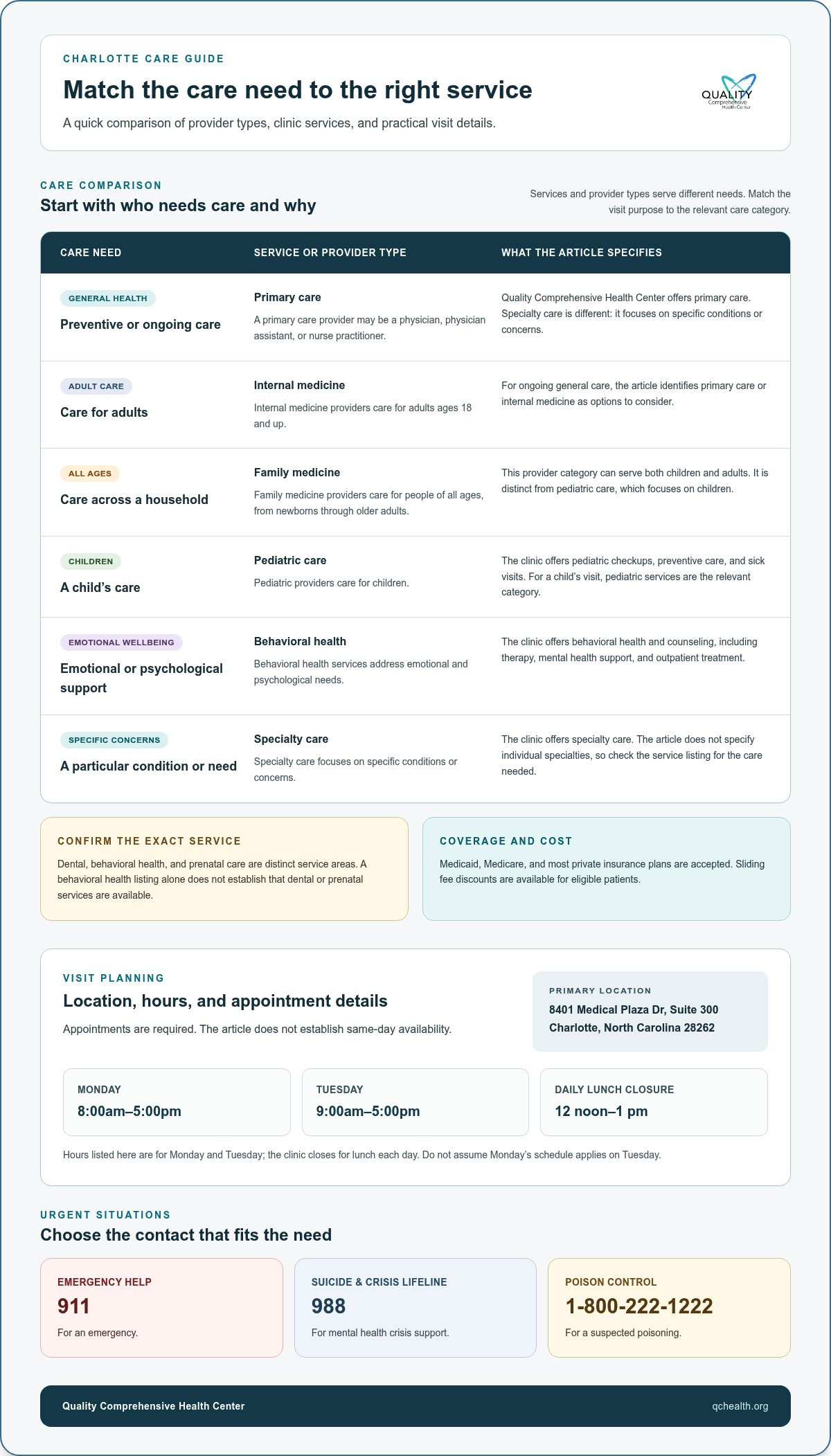
Care needs can differ across one household. A community health clinic in Charlotte, NC can help connect people with different kinds of care. QCHC offers primary care, pediatric care, specialty care, and behavioral health services. Primary care supports preventive and ongoing health needs, while specialty care focuses on specific conditions or concerns.
Provider type can help you find a good fit. A primary care provider may be a physician, physician assistant, or nurse practitioner. Internal medicine providers care for adults ages 18 and up. Family medicine providers care for people of all ages, from newborns through older adults. Pediatric providers care for children.
To see how a local clinic presents its care, watch this video:
In Charlotte, look for clinics that name the service you need: dental, behavioral health, or prenatal care. These are distinct care areas, so a behavioral health listing alone doesn’t establish that dental or prenatal services are available.
Behavioral health services address emotional and psychological needs. QCHC offers behavioral health and counseling, including therapy, mental health support, and outpatient treatment. Primary care and specialty care serve different purposes, though a person may need both as health needs change.
Women’s health needs can include pregnancy and menopause. For pregnancy-related care, look for prenatal services specifically. For children, pediatric care is the relevant provider category; family medicine serves both children and adults. QCHC offers pediatric care, including checkups, preventive care, and sick visits, helping families match a visit to the person receiving care.
Access matters for people without health insurance. Mecklenburg County’s listed free and reduced-cost healthcare providers serve residents who don’t have health insurance. The county guide is current as of October 2026. It recommends contacting providers directly about services or appointments, making those details practical first steps.
Underinsured patients can compare care options by considering the visit’s purpose, provider type, and coverage. Start with the main need, such as an adult checkup, a child’s care, or behavioral health support. Then identify the matching service and ask about appointment arrangements. This keeps the search focused on the care needed.
For example, a parent seeking care for a child can look for pediatric services. An adult seeking ongoing general care can consider primary care or internal medicine. Someone seeking pregnancy-related care should look for prenatal services specifically. Matching the service to the patient and need makes clinic options easier to understand. A clear description of the need can also help focus an appointment inquiry.
Charlotte Community Health Clinic offers uninsured patients a discount program based on income and family size. People considering care there can ask the clinic how to find out whether the program may apply to them and what information is needed to discuss it. It can be useful to raise cost questions when arranging care, along with the service needed and the type of provider sought. That way, patients can consider the care option and the possible discount together, rather than assuming that a listed service or appointment automatically determines what they may pay.
Clinic location and contact information
A Charlotte clinic’s primary location is 8401 Medical Plaza Dr, Suite 300, Charlotte, North Carolina 28262. Use the full address when planning your route, since the suite number helps distinguish the clinic from other offices at the same location. Before traveling, note the clinic’s listed hours and appointment requirement. Appointments are required, so arrange a visit rather than arriving as a walk-in. Same-day availability isn’t established by that rule.
The listed schedule varies by weekday. Monday hours are 8:00am to 5:00pm, while Tuesday hours are 9:00am to 5:00pm. The clinic closes for lunch from 12 noon to 1 pm each day. For example, plan around the lunch closure if you need to reach staff or attend an appointment. Don’t assume the Monday schedule applies on Tuesday.
Clinic directories can become outdated as contact details and schedules change. Mecklenburg County’s free and reduced-cost clinic guide is current as of October 2026. The county recommends contacting healthcare providers directly about services or appointments. Use that step to confirm the right location and arrange your visit, especially if you’re relying on a printed listing or an older saved record.
For practical planning, keep the clinic’s name, street address, suite, and appointment details together. If you’re helping a family member, share the complete address and the scheduled time, rather than only the street name. A clear plan can also include the weekday’s opening time and the daily lunch closure. These details help avoid arriving before opening or during the midday break.
Urgent situations need a different contact than a clinic appointment. Mecklenburg County lists 911 for emergency help, 988 for the Suicide & Crisis Lifeline, and 1-800-222-1222 for Poison Control. Use 911 for an emergency, 988 for mental health crisis support, and Poison Control for a suspected poisoning. These contacts serve different needs, so choose the one that fits the situation.
For non-emergency care, use the scheduled-appointment process and keep the address handy. If you’re exploring care options through community health information, make a note of the clinic’s location and appointment details before planning travel. In a crisis or emergency, use the appropriate Mecklenburg County contact instead of waiting for a routine clinic visit.
Free and reduced-cost healthcare providers in Mecklenburg County
Mecklenburg County lists free and reduced-cost healthcare providers for residents without health insurance. Its clinic guide is current as of October 2026. That makes it a useful starting point for identifying community care options. The guide helps narrow the search, while each provider explains its own services and appointment process.
“Free” and “reduced-cost” describe different ways clinics may lower financial barriers. Free care means a covered service carries no charge for the patient. Reduced-cost care means the patient may pay less than the standard charge. Which services qualify and how costs are determined can differ by provider. QCHC offers sliding fee discounts to eligible patients.
Start by identifying the main reason for care. A routine health concern, a child’s visit, or behavioral health support may call for different services. Then use the Mecklenburg County guide to find providers that address that need. A service match matters: a clinic’s reduced-cost program doesn’t mean every service is offered.
Use a practical sequence to narrow your options:
Choose the service or type of visit you need.
Find providers in the Mecklenburg County guide that list that care.
Contact the provider directly about services and appointments.
Ask what information is needed to discuss eligibility and cost.
Before arranging an appointment, identify the service you need and ask about the next step. For example, someone seeking behavioral health support can ask about that specific service rather than assuming it falls under general medical care. QCHC offers behavioral health and counseling services, as well as primary and specialty care.
Prepare a short list before calling. Include the patient’s age group, the reason for care, and any questions about insurance. Ask how the clinic handles sliding fee discounts for eligible patients. Sharing those details helps staff direct your inquiry to the relevant service and explain the next step.
People without insurance can explore local care options and compare providers by care type and payment arrangements. A listing doesn’t mean every clinic offers the same services or financial options. QCHC provides primary, pediatric, specialty, and behavioral health care, accepts Medicaid, Medicare, and most private insurance plans, and offers sliding fee discounts to eligible patients.
Keep the guide’s date in mind as you plan. Because the Mecklenburg County version is current as of October 2026, it gives a dated reference point, not a substitute for direct provider details. Contacting a clinic helps clarify current services and appointment arrangements. This is especially useful when the patient needs a particular type of care or has questions about eligibility.
Charlotte Community Health Clinic was started in Charlotte in 2000 by a group of committed volunteers. That background does not establish what care is available now, whether a particular service is free or reduced-cost, or how appointments are arranged. Anyone considering the clinic should confirm its current services and financial policies directly, then decide whether the available care fits the need.
Which Charlotte community clinics accept new patients?
New-patient acceptance is clinic-specific, so a directory listing alone doesn’t establish whether a clinic can schedule you. Mecklenburg County recommends contacting healthcare providers directly about services and appointments. Ask whether the clinic is accepting new patients for the specific care you need. A clinic may handle primary care, pediatric care, and behavioral health through different appointment processes.
For care in Charlotte, identify the service you need and ask about the next step for arranging a visit. Appointment processes can differ depending on the care requested. Contact QCHC by phone or use its online scheduling option, and name the specific service so your inquiry can be directed appropriately.
Make your inquiry specific. Give the clinic the patient’s age group and the reason for seeking care. Then ask whether it accepts new patients for that service. For example, a request for an adult primary care visit differs from a request for pediatric or behavioral health care. Naming the service helps staff direct your question.
The Mecklenburg County free and reduced-cost clinic guide is current as of October 2026. Acceptance can change as clinic schedules and appointment capacity change. Contact the listed provider directly for current appointment information. Keep the guide’s date in mind when using a saved or printed copy.
Before calling, prepare a short list:
State that you’re a new patient seeking care.
Name the service and patient age group.
Ask whether the clinic accepts new patients for that service.
Ask what information is needed to arrange an appointment.
If you’re uninsured, ask about the service you need and the clinic’s payment options. QCHC offers sliding fee discounts to eligible patients. People with insurance can ask about their specific plan, since the center accepts Medicaid, Medicare, and most private insurance plans. Avoid assuming that coverage or payment arrangements apply identically to every patient.
For a household with different care needs, ask about each person separately. A parent might be seeking pediatric care for a child and primary care for an adult. Those requests may involve different providers or appointment arrangements. Giving the clinic both needs clearly helps staff explain the right next step for each patient.
Write down the clinic’s response, including the service discussed and any instructions for arranging a visit. If the first clinic cannot schedule the care you need, use the Mecklenburg County guide to identify another relevant provider. Contact that provider directly, as the county recommends, and ask focused questions about new-patient appointments and the service needed.
When arranging care, ask about an appointment for the specific service you need. Naming the service helps clarify the appropriate next step.
Do Charlotte community clinics accept Medicaid, Medicare, or private insurance?
Insurance acceptance varies between community clinics. QCHC accepts Medicaid, Medicare, and most private insurance plans, offering a local care option in Charlotte. “Most” does not mean every plan, so have your plan details ready when arranging care.
QCHC accepts Medicaid and Medicare, as well as most private insurance plans. “Most” doesn’t mean every plan, however. Coverage can depend on your specific plan and the service you need. Have the exact plan information ready when you arrange care.
Before arranging care, gather your insurance card and plan details. Identify the patient who needs the appointment and the service they’re seeking. QCHC accepts Medicaid, Medicare, and most private insurance plans. Keep the card available for registration, since it contains the member and plan details used to identify coverage.
Use these steps to organize your insurance information:
Identify whether your coverage is Medicaid, Medicare, or private insurance.
Read the plan name shown on your insurance card.
Match the planned visit to the relevant care type.
Keep the insurance card ready when arranging or attending care.
For people with Medicaid, distinguish general acceptance from the details of a particular plan. QCHC accepts Medicaid, but coverage terms can vary by plan. Medicare patients should likewise bring their Medicare information. People with private coverage should use the exact plan name, rather than only the insurer’s brand.
If you have more than one type of coverage, organize each card before the visit. For example, a family may have different plans for a child and an adult. The patient’s own card helps staff identify the relevant plan. Keep coverage information separate for each person, even when they share a household.
Without insurance, you can ask QCHC about its payment options. Sliding fee discounts are available for eligible patients. If you have coverage, the center accepts Medicaid, Medicare, and most private insurance plans. Have your plan details ready, or explain that you’re uninsured when discussing care.
Bring your insurance details into the care-planning process. Explore care options and consider which service best matches your needs. Knowing whether you have Medicaid, Medicare, private insurance, or no coverage helps you take a clearer next step.
Quality Comprehensive Health Center: Specialty care
Quality Comprehensive Health Center offers specialty care for people seeking support with specific health needs. It also provides primary care, pediatric care, and behavioral health services. This range can be relevant when you’re looking for care for yourself or a child, or support for physical and behavioral health needs. Choose the service that best matches your reason for seeking care, then call or schedule online.
For local patients, a community health clinic in Charlotte, NC can be part of a more accessible path to care. Quality Comprehensive Health Center brings several care options together for individuals and families. To learn more or discuss your care needs, visit qchealth.org.
Take the Next Step Toward Care That Fits
Choosing a community health clinic in Charlotte, NC is a chance to think beyond one appointment. Consider what would help you feel supported over time: a place to discuss a specific concern, care for a child, or support for your own health needs. QCHC brings medical, behavioral, pharmacy, and support services together in Charlotte. Start by naming your priority and deciding what questions matter most to you.
Quality Comprehensive Health Center offers specialty care, primary care, and pediatric care. These options can help individuals and families explore care suited to different needs. You don’t have to map out every future health decision before reaching out. Start with the concern you want to address now, and use that conversation to guide what comes next.
To take that step, contact Quality Comprehensive Health Center. A thoughtful question can be the beginning of a clearer path forward. Your health matters, and support starts with taking the next step.
Frequently Asked Questions
What community health clinics are located in Charlotte, NC?
Quality Comprehensive Health Center is a community-based healthcare provider in Charlotte, North Carolina. Mecklenburg County’s guide is another way to identify local providers, including clinics serving residents without insurance. For example, someone looking for care for a child can compare providers that offer pediatric services. Choose a clinic based on the patient’s needs and the type of care sought, rather than assuming every community clinic offers the same services.
What services do community health clinics in Charlotte offer?
Quality Comprehensive Health Center offers primary, pediatric, specialty, and behavioral health care, as well as HIV/STD screenings and pharmacy. For example, someone seeking HIV testing or counseling can ask about HIV-related services, while a family seeking routine care for a child can ask about pediatric services. Match the service to your need, since clinics don’t all provide the same care.
How can I make an appointment at a community health clinic in Charlotte?
Contact the clinic directly or use its online appointment scheduling option. At Quality Comprehensive Health Center, you can call to schedule or book online. Before arranging a visit, identify the patient and the service needed, such as pediatric care or behavioral health support. Have your insurance details ready if you plan to use coverage. If you’re uninsured, ask about the clinic’s process for discussing care options.



Comments